Key Takeaways (or TL;DR)
- An Uber clone is a business-ready platform that allows you to launch and manage a modern taxi service without building the technology from scratch.
- Starting your EV business is a structured journey that begins with deep market research and moves into a solid execution plan for your fleet and app deployment.
- By entering the market now, you can capture a loyal “green” customer base while benefiting from the significantly lower daily running costs of electric vehicles.
- Launching an EV taxi booking business with Uber clone technology typically requires between $20,000 and $300,000+, depending on your fleet size and the complexity of the features you choose.
- The industry is moving toward high-tech breakthroughs like self-driving robotaxis, AI-powered route planning, and “subscription” models that make taxi ownership easier for drivers.
According to recent data from Statista, the global EV market is expected to reach a massive $996.3 billion in revenue this year. This surge is due to the constant rise in fuel prices triggered by various geopolitical situations. The pressure to adopt sustainable mobility solutions is at an all-time high.
For entrepreneurs looking to move towards an EV taxi business, this is a perfect opportunity. Moreover, an EV taxi booking business with Uber clone allows entrepreneurs to launch a pre-engineered digital ecosystem. Instead of months of ground-up development, startups can deploy advanced rider apps, driver apps, and fleet management systems within weeks.
In this guide, we will break down the workflow to launch an EV taxi business with Uber clone, step-by-step. We will also discuss realistic ROI expectations and your timeline to profitability.
What is the EV Taxi Booking Business with Uber Clone?
An Uber clone is a sophisticated, ready-to-deploy mobility platform designed to launch and scale on-demand transportation services with speed and precision. The solution is a replica of Uber Green’s eco-friendly transportation model. The entire application architecture is pre-designed for you, and it is powered by AI-driven features.
The process begins with customizing the model’s features, UI, and logo as per the core business goals. It normally takes a week. The next three to six weeks will go into further refining the UI/UX interfaces for riders, drivers, and admins.
Meanwhile, the backend is customized to track real-time data and to process all transactions through a secure environment. Finally, the cycle concludes with rigorous testing, followed by a final demo before deploying into the platform.
Why Start an On-Demand Electric Taxi Business with Uber Clone?
The EV taxi market is growing competitive with more startups and businesses entering the space to meet the growing demand for eco-friendly travel solutions. In such scenarios, starting your electric taxi business with an Uber clone serves as a competitive advantage as it allows you to enter the market quickly with a market-tested approach.
Besides, it also provides several other benefits, like:
- Low development costs and time compared to building one from scratch.
- Being a white label solution, it is completely customizable as per your brand needs.
- Scalable infrastructure allows you to scale your operations as and when needed.
- Inspired by Uber’s proven business model, it reduces overall risk, especially for startups.
Difference Between Traditional Taxi & EV Uber Clone
The following table gives you a quick difference between a traditional taxi and an EV Uber clone to understand the hype for the green platform.
| Feature | Traditional Taxi Clone | EV Uber Clone |
| Fleet management | Tracks standard fuel management | Real-time battery and range monitoring |
| Route optimization | Based on traffic and distance | AI-routes including charging station stops |
| Driver app tools | Accept/decline ride requests, verify passengers, check earnings, real-time routing, and trip history. | Everything in traditional taxi clone + low battery alerts + nearby-plugin maps + emission-saving reports |
| Rider choice | Economy, Luxury, or XL options. | Green category for zero-emission rides |
| Pricing Logic | Standard base + surge pricing. | Eco-incentives & EV-specific lower commissions |
| Infrastructure | Standard Cloud Backend. | IoT Integration with EV Telematics |
Step-by-Step Guide to Launch EV Taxi Business with Uber Clone
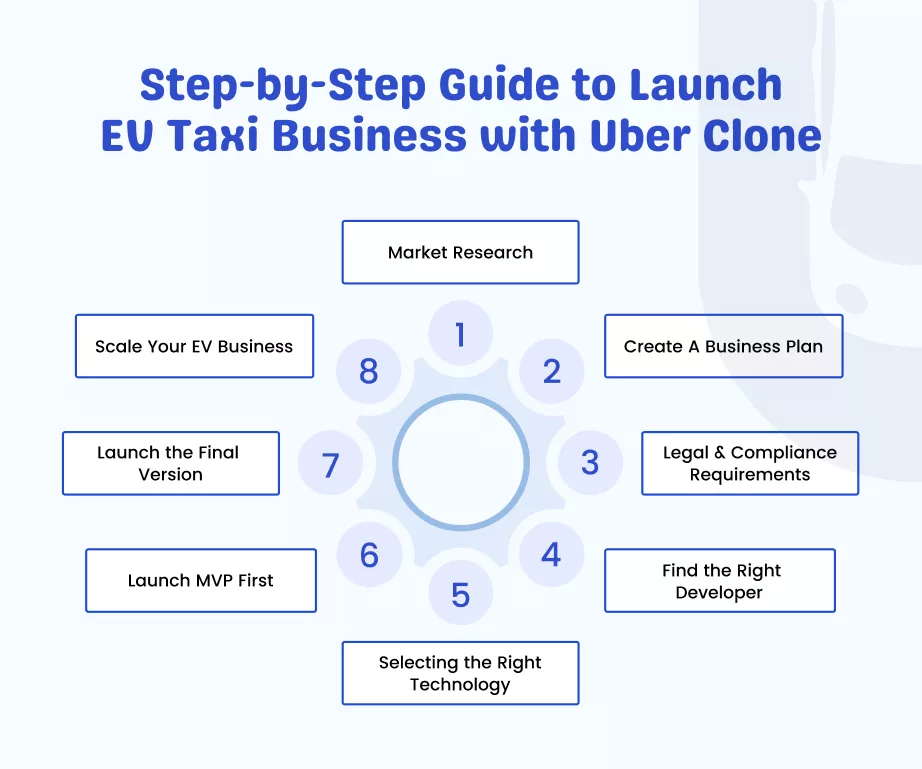
A new-age EV taxi business model seeks to circumvent the pitfalls of customary ride-hailing models with a modern tech stack․ Here is a short guide to building an on-demand electric taxi business with Uber clone in 2026․
Step 1: Market Research & Feasibility Planning
There are a lot of external variables that can affect the efficient operation of EV fleets, from grid capacity to charging dead zones, and feasibility planning allows a company to avoid putting cars in areas where they will not be efficiently charged․
Investigate local EV incentives to determine areas with existing fast charging infrastructure and high volumes, and survey users to determine whether they prefer higher fares or shorter wait times in an EV fleet․
Step 2: Create A Business Plan
Launching an EV operation requires a significant initial Capital Expenditure (CapEx) for fleet procurement and infrastructure, but it is offset by a relatively low Operating Expense (OpEx) over time. You will need a model to communicate to investors when your EV fleet will start generating profits compared to a conventional fleet․
The first step is figuring out how you’ll be monetizing․ For example, ride commissions, priority pass, or B2B partnerships․ A 3-year financial projection of fuel savings and maintenance reductions, among other things, is necessary․
Step 3: Legal & Compliance Requirements
Alongside these general risks, electric vehicle fleets face regulatory risk from electricity resale regulations and environmental regulations for battery storage and recycling․
Also consider registering your business as a Pvt Ltd or an LLP, under which you can get permits․
Some states offer green plate incentives or allow EVs to access special lanes․ Check if your cities of interest also have these incentives․
Step 4: Find the Right Developer
Look for an EV taxi app developer with a background in IoT telematics and real-time data synchronization․ Ensure the developer appreciates basic electric fleet concepts like monitoring the State of Charge (SoC)․
Hire mobility and greentech developers, and prefer white-label mobility platforms which enable complete ownership and administrative access to the code․ These will be the best value․
Step 5: Selecting the Right Uber Clone Technology
An ideal Uber clone tech stack, you may want to add some layers for supporting electric vehicles․ For your front-end, Flutter or React Native are strong, performant frameworks that work on both Android and iOS․ For backend auto-scaling with peak demand, consider Node․js or Laravel hosted on AWS or Google Cloud, which also ensures absolute ownership of your source code․
Step 6: Launch MVP First
Creating the Minimum Viable Product (MVP) lets you test your electric cab booking business with Uber clone without investing a ton of money․ You have to know how to spot local problems early on․
To build the MVP, focus on the following four features:
- Quick booking
- Accurate GPS tracking
- Secured transactions
- EV-specific driver dashboard
When the MVP is ready, launch it in one city with heavy traffic and gather data․ At this point, you can also test your carbon-saver tracker․ The data can be used as a marketing tool to build early brand loyalty․
Step 7: Launch the Final Version
The final product should be fully integrated with your MVP feedback so that all parties can expect high user retention․
At this point, your app should be feature-complete (e․g․, multi-stop bookings, loyalty programs, in-app games, etc․)․ Make sure to QA that your infrastructure can handle thousands of concurrent users, and that you’ve covered App Store Optimization (ASO)․
Step 8: Scale Your EV Business
Once your business becomes profitable in one city, you may want to expand to other cities, but you need to know how to manage the costs of operations and how to avoid reaching a plateau in expansion due to lack of charging stations․
Using the original user data, target your next demographic and maybe build your own fast-charging hubs in places with no service to limit driver downtime․
B2B partnerships can begin targeting larger corporations that have annual ESG (Environmental, Social, and Governance) goals to meet․
From Fleet Procurement to App Deployment: Get the Definitive 2026 Roadmap for Your EV Taxi Business
Benefits of EV Taxi Booking Business with Uber Clone in 2026
Some of the many advantages of starting an on-demand electric taxi business with Uber clone in 2026 include:
International Sales Growth of EVs
Besides, the EV industry has become mainstream, with passenger vehicles accounting for nearly two-thirds of the total market value of electric vehicles․ You can ensure your Uber clone model is positioned to catch the tide․
Shift Toward Carbon Neutrality
Carbon neutrality is the state of net-zero carbon dioxide (CO2) emissions, achieved by balancing CO2 emissions with removal, or eliminating emissions altogether. For many countries around the world, the aim is to achieve net-zero carbon emissions by 2050.
To achieve that goal, government subsidies and incentives can significantly lower the high entry cost of an EV fleet. Local schemes, like the Federal Electric Car Tax Credit, get tax exemptions and subsidize your fleet’s registration fees.
Consumer Preference for Green Transportation
According to a recent study by IEA, electric car sales topped 17 million worldwide in 2024. Just the additional 3.5 million cars sold in 2024 compared to 2023 outnumber total electric car sales in the whole of 2020. That clearly indicates ride-hailing providers should invest in EV fleets because that is where the demand has shifted.
Rising Fuel Prices vs EV Operational Cost Advantage
For a regular taxi business, fuel is the largest variable expense. However, EV fleets can operate at energy costs as little as 7p per mile, compared to 19-21p per mile for petrol vehicles. That is a whooping 65% reduction in daily energy expenditure.
Additional savings come from maintenance. EVs have just 20 moving parts compared to over 2,000 in ICE vehicles. That leads to 50% lower maintenance and repair costs over a 10-year period.
Total Cost Breakdown for Starting an Electric Cab Booking Business with Uber Clone
A basic MVP will typically cost between $20,000 and $45,000, while a complete enterprise solution with EV telematics can be anywhere between $90,000 and over $300,000, depending on the size of the fleet and how advanced the technology is․
Application Development Cost
A basic Uber clone app consists of at least three interfaces:
- Passenger app for making bookings and payments
- Driver app for trip management
- Admin dashboard for fleet oversight
The Uber clone app development cost for a mid-range system may range from $50,000 to $80,000 and come with features such as dynamic pricing and analytics․
EV Vehicle Procurement Cost
Electric vehicles are your largest area of CapEx, and there are a large number of EVs available at all price points․ As of 2024, in China, 40% of the electric vehicles available were priced below USD 25 000, and more than half of the electric vehicles sold were below USD 30 000 IEA’s Global EV Outlook 2025․
In Europe, electric vehicles from car manufacturers such as Renault, Volkswagen, Hyundai or BYD were offered for less than EUR 25 000․ 20% of electric sports utility vehicles (including pick-up trucks) sold in the US market were offered for less than the average cost of conventional sport utility vehicles in that study․
Charging Infrastructure Cost
The development of EV charging infrastructure requires a heavy upfront investment. The average cost of installing a DC fast charger can cost anywhere between $28,000 to $1,40,000. A majority of this cost goes towards equipment, installation, and grid upgrades.
Licensing Cost
Operating a commercial fleet without the correct permits can attract heavy regulatory fines. In cities with zero-emission zones, only special licensed EVs are permitted to operate.
The cost of registration and a special license may vary from one country to another. For example, the standard registration fee for new EVs in the USA is $400, to be renewed at $200 per year.
Marketing Budget
A ride-hailing app is a marketplace for riders and drivers. So, you must market to both parties simultaneously with different campaigns.
Plan to spend at least 10%-20% of your projected revenue on marketing during the early-stage, 7%-10% during the growing stage, and 4%-7% once the business matures.
This typically averages $1000 to $10,000+ per month to cover SEO, social media ads, and driver referral bonuses.
Operational Expenses
In the ride-hailing business, the operational expenses (OpEx) are the difference between scaling and folding. There will be fixed overheads, such as loan payments, EV depreciation, and insurance premiums. The total cost may be anywhere between $40,000 to $60,000 per month.
ROI Estimation
EVs have lower variable costs per mile. The more your cabs are functional, the faster they fetch ROI compared to ICE vehicles.
The simple formula to calculate ROI is as follows:
ROI (%) = {(Total Savings – EV Rental Costs) / EV Rental Costs} × 100
Break-Even Timeline
The breakeven point for an EV fleet can be somewhere between 2.5 and 4 years, depending on local electricity tariffs and government subsidies. If EVs are operational 24/7, the breakeven point can even occur within a 3-year cycle.
Future Trends in Electric Mobility & Ride-Hailing
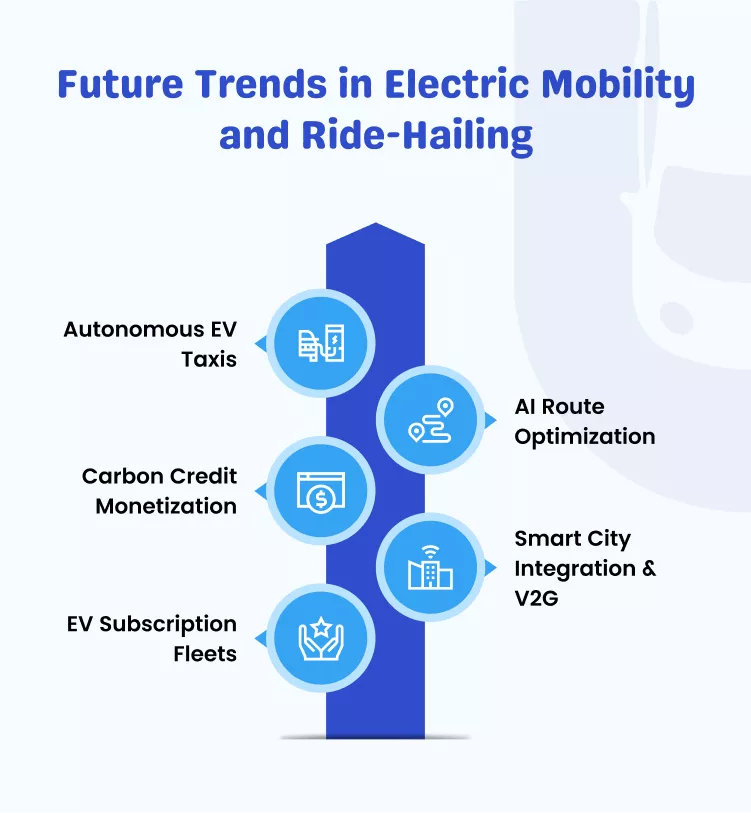
Let’s take a look at some of the most probable future scenarios of the EV space by the next couple of years.
Autonomous EV Taxis
The market for autonomous, self-driving vehicles (robotaxis) is entering a phase of exponential growth. It is projected to jump from $18.27 billion in 2026 to over $2 trillion by 2034. The cost per mile is projected to drop to up to $0.50 by 2030, making them 60% cheaper than traditional EV fleets.
AI Route Optimization
Modern Uber clones will use EV-aware routing. AI will analyze real-time traffic data through machine learning to dynamically plan routes for optimizing last-mile deliveries. The AI will also be able to analyze ambient temperature, charging availability, and battery health to help drivers with predictive uptime. That means fleet owners can plan scheduled maintenance based on actual diagnostic signals.
Carbon Credit Monetization
EV fleets can generate tradable carbon credits by measuring emission reductions from EVs compared to ICE vehicles. Another way to measure credits is by tracking electricity consumption at charging stations. The generated credits can be traded in government-regulated marketplaces to earn monetary benefits or meet CSR goals.
Smart City Integration & V2G
In the near future, EV taxi fleets will act as a distributed battery network for a smart city infrastructure. Taxis can absorb excess renewable energy during low-demand hours and release it back to the grid during peaks. This is possible by using vehicle-to-grid (V2G) technology. That means, EVs can earn revenue in this manner even when not carrying passengers.
EV Subscription Fleets
The EV industry is slowly moving toward Mobility-as-a-Service (MaaS) subscription models. Regular commuters and corporate employees are able to use EV fleets for a fixed monthly subscription towards EVs, charging infrastructure, maintenance, and software. This will reduce capital expenditure and improve operational efficiency for fleet owners.
A basic Uber clone app can cost between $20,000 and $45,000. A full-scale enterprise solution with integrated EV telematics can range from $90,000 to over $300,000, depending on fleet size and technological complexity. Let’s understand the individual factors contributing to these figures.
Launch Your EV Taxi Platform Faster with a Ready-Made Uber Clone. Reach Out to Us for a Demo!
Conclusion
Electric mobility in 2026 is the new standard for transportation businesses. Starting an EV taxi booking business with an Uber clone is a smart move to build a futuristic business. As battery costs have dropped below $100/kWh, and countries are expanding Zero-Emission Zones, green platforms that launch today hold a clear advantage.
However, building an entire EV taxi booking ecosystem is a cost-intensive process, and there will be lots of space for costly errors.
If you want to start your EV taxi business with an Uber green clone that has AI capabilities already built in, our ready-to-deploy solution gives you a powerful head start. You get enterprise-grade technology without the cost and complexity of building everything from scratch. Quickly launch your app, loaded with advanced features. Seamless user experience with separate dashboards for rider, driver, and admin control.