Key Takeaways (or TL;DR)
- Qatar’s ride-hailing market is growing fast – driven by Vision 2030, a large expat population, and post-FIFA 2022 infrastructure investments.
- Your app must meet Qatar’s MOCI registration, Ministry of Transport licensing, and data localization requirements before launch.
- Only 7 companies hold active ride-hailing licenses in Qatar – Careem exited the market in 2023, leaving a competitive gap that well-positioned new entrants can capture.
- An Uber clone taxi app is the fastest way to launch a ride-sharing solution in Qatar without building everything from scratch.
- Your taxi app in Qatar requires bilingual interfaces, women-only ride options, corporate account modules, and multi-language support for Qatar’s diverse expat population.
Qatar’s transportation landscape is shifting – and fast. The ride-hailing market is small, structured, and growing, which makes it exactly the kind of market where a well-prepared entrepreneur can build a durable, profitable business.
The market is driven by Qatar’s high smartphone penetration, an 85%+ expat population, and a government that is actively investing in smart city transport infrastructure.
The opportunity became sharper in February 2023, when Careem exited Qatar, reducing the number of active licensed operators to just seven. That is not a crowded market. It is a tightly regulated one, with room for new entrepreneurs who approach it correctly.
This guide covers everything you need to develop Uber clone taxi app in Qatar – from the regulatory framework and step-by-step development process to the features, cost structure, and platform decisions that determine whether your ride-hailing solution in Qatar succeeds from day one.
Why Qatar Is a High-Opportunity Market to Launch a Ride-hailing Solution?
Qatar sits at a unique intersection of wealth, tech adoption, and underserved mobility regions. The country’s GDP per capita is among the highest globally, yet its public transport network still leaves significant gaps – especially for residents outside Doha’s central zones.
The Qatar taxi market size is expected to increase from USD 481.28 million in 2025 to USD 496.15 million in 2026 and reach USD 577.69 million by 2031, growing at a CAGR of 3.09% over 2026-2031. That growth is being driven by several structural forces:
Large Expat Population
Over 85% of Qatar’s residents are expatriates – a demographic highly familiar with and dependent on app-based ride-hailing services.
Post-FIFA 2022 Infrastructure
The World Cup triggered massive investment in roads, metro connections, and digital services. Ride-hailing apps are a natural complement to this network.
Vision 2030 National Agenda
In Qatar National Vision 2030, the government is actively investing in smart city infrastructure, digital services, and mobility technology as part of its long-term development roadmap.
Low App Penetration vs. High Demand
Qatar has fewer established ride-hailing platforms than neighboring UAE or Saudi Arabia. That gap is your opportunity.
Cash-to-Digital Shift
Digital payment adoption in Qatar accelerated sharply post-2022. Riders are comfortable paying through apps – reducing a common friction point.
From Years of Experience in GCC Markets – What We’ve Seen
- Early movers in emerging Gulf markets build brand equity fast. The first app riders trust becomes the default – that loyalty is hard to displace later.
- Don’t underestimate demand from women riders. Female-only driver options and in-app safety features have driven significant retention in GCC markets.
- Localisation isn’t just language. Prayer time notifications, Ramadan scheduling adjustments, and right-to-left UI all matter more than founders expect.
- Avoid launching in all of Qatar at once. Start with Doha’s key corridors – airport, The Pearl, Lusail – then expand based on real demand data.
Regulatory Requirements – What You Must Know Before You Develop an Uber Clone Taxi App in Qatar
Qatar’s regulatory environment is one of the most important factors shaping the ride-hailing market – and one of the least covered topics in most guides on the subject. Getting compliance right is not a post-launch consideration. It is a pre-launch prerequisite.
Ministry of Transport Licensing
All ride-hailing operators in Qatar must obtain a commercial license from the Ministry of Transport. This license defines the scope of service – vehicle types, service areas, and fare structures. The licensing process requires a formal business entity registered in Qatar, a detailed business plan, and documentation of operational systems, including dispatch, driver verification, and vehicle standards.
Only 7 companies currently hold this license. The barrier is not prohibitive – but it is procedural and requires preparation. Also, check Uber clone licensing to understand legal and regulatory framework for launching a ride-hailing service, including the documentation and compliance steps applicable to Gulf markets.
Ministry of Interior (MOI) Driver Requirements
All drivers operating on a licensed ride-hailing platform in Qatar must hold a valid commercial driving license issued by the MOI. The minimum age for taxi drivers in Qatar is 21.
Driver Compliance
- All drivers must hold a valid Qatar driving license
- Vehicles must pass the annual Fahes (vehicle inspection) test
- Commercial vehicle insurance is mandatory – personal policies do not apply
- Driver background checks are required and must be documented
Your platform must support this workflow, automated identity verification, license upload and validation, and ongoing compliance monitoring, continued throughout the driver’s active period on the platform.
Vehicle Standards and GPS Requirements
All vehicles used in licensed ride-hailing operations must pass regular safety inspections conducted by Qatar’s relevant transport authority. GPS tracking is mandatory for all commercial ride-hailing vehicles. Karwa, as the state operator, sets the visible benchmark for vehicle standards that rider expectations are calibrated against.
Data Privacy and Payment Compliance
Qatar’s Personal Data Privacy Protection Law (Law No. 13 of 2016) governs how user data, including location, payment information, and trip history, must be collected, stored, and processed. Data hosting within Qatar or the GCC is strongly preferred to meet data sovereignty requirements.
In-app payment processing must comply with Qatar Central Bank (QCB) regulations. Payment gateway integrations must use QCB-approved providers. This affects both your technical architecture and your platform choice – not all generic ride-hailing platforms are pre-integrated with QCB-compliant payment solutions.
Arabic Language Requirement
Customer-facing interfaces for commercial services in Qatar must support Arabic. This is not a soft recommendation. It is a functional requirement for regulatory compliance and commercial viability. Your passenger app, driver app, and admin dashboard must all support Arabic, with right-to-left text rendering and Arabic-language notifications.
Top 3 Compliance Mistakes We’ve Seen in GCC Launches
- Launching first, complying later. This approach works in some markets – it does not work in Qatar. Regulators here move quickly, and the fine isn’t worth it.
- Using a generic privacy policy. Qatar’s data protection law is specific. A copy-paste policy from a Western app will not satisfy local requirements.
- Skipping vehicle insurance verification at the driver onboarding stage. One uninsured incident can expose your business to significant legal liability.
Ready to Navigate Qatar’s Regulatory Requirements without the Guesswork?
How to Develop Uber Clone Taxi App in Qatar – A Step-by-Step Process
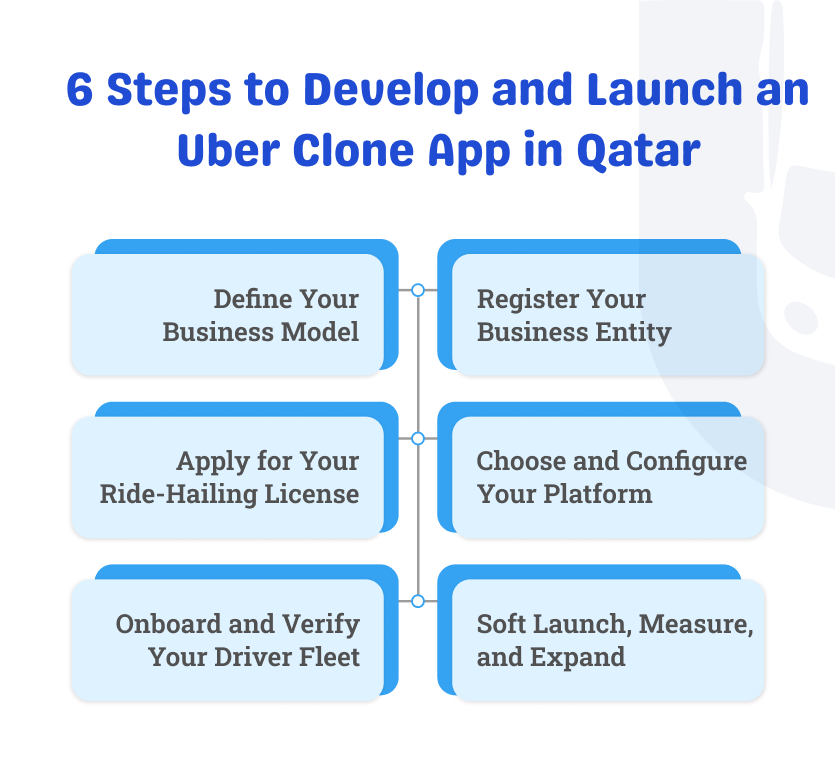
To develop Uber clone taxi app in Qatar involves both technological decisions and a regulatory journey. The two run in parallel, and the entrepreneurs who succeed treat them that way from day one.
Step 1: Define Your Business Model and Service Scope
Before writing a single line of code or filing a single document, define what your service will actually be. Will you operate standard city rides, women-only rides, corporate accounts, airport transfers, or a multi-service combination? Each service type affects your licensing application, your vehicle requirements, and your app feature set. Qatar’s corporate expat community is particularly underserved for business-grade transport – a strong starting niche for a new entrant.
Step 2: Register Your Business Entity in Qatar
You must have a legally registered business in Qatar before applying for a ride-hailing license. Options include a Limited Liability Company (LLC) with a Qatari partner holding 51% ownership, or a branch office of a foreign company. The Qatar Financial Centre (QFC) and Qatar Free Zones also offer alternative structures for foreign investors. Legal and commercial registration is handled through the Ministry of Commerce and Industry.
Step 3: Apply for Your Ministry of Transport Ride-Hailing License
Submit your commercial license application to the Ministry of Transport with your business plan, operational documentation, driver verification protocols, and vehicle standards compliance plan. This process takes time, which is exactly why your platform development should run in parallel, not after, so you are ready to launch the moment your license is approved.
Step 4: Choose and Configure Your Platform
This is your most consequential technical decision. Custom development takes 6-12 months and costs $40,000-$150,000+. A white-label platform configured for Qatar’s market – Arabic interface, QCB-compliant payment gateway, GCC-region data hosting – gets you live in 2-6 weeks at a fraction of the cost. Your platform must be Qatar-ready on day one: bilingual, compliant, and capable of handling the regulatory workflows your license requires.
Step 5: Onboard and Verify Your Driver Fleet
Set up your MOI-compliant driver verification workflow: commercial license upload, identity verification, background check integration, and vehicle inspection documentation. Qatar’s standards are clear – and your platform must enforce them automatically, not manually. Pre-recruit your initial driver cohort through corporate networks, expatriate community groups, and direct outreach to existing commercial drivers looking for a better platform.
Step 6: Soft Launch, Measure, and Expand
Begin with Doha’s city center – the highest-density demand zone. Track ride completion rate, average wait time, and driver utilization in your first 30 days. Use that data to refine your dispatch model, adjust your pricing, and identify your strongest corridors. Then expand methodically: West Bay and the Pearl for corporate and premium rides, Lusail for the growing new-city population, and Al Wakrah or Al Khor for intercity demand.
What To Do – and Avoid – During Development
- DO define your MVP before development begins. Scope creep is the single biggest cause of blown budgets and delayed launches.
- DO test on real Qatar-based device/network conditions. App performance on slower mobile networks differs significantly from your developer’s WiFi.
- AVOID building on a rigid, monolithic codebase. You need the ability to add features post-launch without rebuilding the entire app.
- AVOID skipping driver app testing with actual drivers. Driver UX issues discovered post-launch cause churn, low ratings, and supply-side problems.
- DO build analytics in from day one. You need trip data, drop-off hotspots, and peak demand windows from week one – not month six.
Key Features Your Uber Like Mobile App in Qatar Must Include
An Uber like mobile app in Qatar is not a generic ride-hailing app with Arabic added as an afterthought. Qatar’s rider demographics, cultural requirements, and regulatory standards demand a feature set that is purpose-configured for this market.
Rider App – What Passengers See
- Instant ride booking with live GPS tracking
- Arabic and English language toggle
- Multiple payment options: card, cash, and local wallets (e.g., QPAY)
- Scheduled ride booking for airport transfers and appointments
- Female-only driver filter for added safety
- In-app chat and emergency SOS button
- Transparent fare estimation before booking
For a complete view of what a production-ready platform includes, Uber clone app user features cover the full rider and driver feature architecture in detail.
Driver App – What Your Fleet Operators Use
- Smart ride-request matching with route optimization
- Real-time earnings dashboard and weekly payout tracking
- Document upload and verification module (Qatar ID, driving license)
- Offline mode for areas with intermittent connectivity
- Navigation powered by Google Maps or HERE Maps
- Driver performance ratings and feedback history
Admin Panel – What You Control
- Live fleet monitoring across the city map
- Dynamic surge pricing configuration by zone and hour
- Driver onboarding approval workflow
- Revenue reports, trip analytics, and rider heatmaps
- Promo code and referral campaign management
- Dispute resolution and support ticket system
Advanced Features That Give Your Qatar Ride-Sharing Solution a Competitive Edge
Beyond the baseline feature set, the ride-sharing solutions in Qatar that consistently outperform are those that go deeper on market-specific differentiation. Advanced Uber clone features include AI dispatch, loyalty systems, and corporate account management. Here are some unique feature lists for the taxi app to launch in Qatar.
Women-Only Ride Option
Karwa has operated a dedicated women-only pink limousine service for years – which demonstrates both the cultural demand and the commercial viability of this feature in Qatar. A women-only ride option, where female passengers can request a female driver, is not a niche feature in this market. It is a mainstream expectation for a significant segment of the rider base.
Corporate Ride Accounts
Qatar hosts a large concentration of multinational corporations, government-affiliated enterprises, and major infrastructure projects, each with significant employee transport needs. Corporate accounts – with consolidated billing, trip reporting, and spending controls – convert these organizations from occasional users into contracted revenue streams. According to Mordor Intelligence, corporate accounts are growing at a 16.36% CAGR in the global ride-hailing market.
Airport Transfer Module
Hamad International Airport (HIA) – ranked among the world’s best airports for four consecutive years – handles over 45 million passengers annually. Pre-booked airport transfers, with fixed pricing and guaranteed availability, are premium-priced and high-margin. This is one of the most reliable revenue anchors available to a Qatar ride-hailing operator from day one.
Multi-Language Support for Qatar’s Expat Demographics
Arabic and English cover the formal requirements, but Qatar’s actual rider base speaks Urdu, Hindi, Tagalog, Nepali, and several other languages. An app that communicates in a rider’s native language builds a loyalty that a bilingual-only platform cannot match. This is particularly impactful in the South Asian and Southeast Asian expat communities that make up a significant share of Qatar’s daily ride-hailing demand.
Eco-Fleet and Hybrid Vehicle Integration
Qatar National Vision 2030 includes explicit green transport targets. Karwa already operates a hybrid-electric fleet. An operator that builds EV and hybrid vehicle support into their platform from launch is positioned as a Vision 2030-aligned partner – which matters both for regulatory goodwill and for the growing segment of environmentally conscious corporate and consumer riders.
Features We’ve Seen Founders Get Wrong
- Over-engineering at launch is the most common mistake. A complex feature set delays go-live by months and confuses early adopters. Launch lean, then iterate.
- The one feature that drives retention in GCC markets above all others: reliability. A fast, accurate ETA beats 10 extra features every time.
- Build the admin panel first in your mind. Operators who can’t see and control their fleet in real-time can’t scale. A weak admin panel kills growth.
- QPAY integration is non-negotiable. Cash riders in Qatar still exist, but digital wallet support directly increases booking conversion rates.
- Don’t skip the scheduled ride feature. Qatar’s airport transfer and corporate travel segments are high-value, and they require advance booking.
Major Taxi Players in Qatar
Karwa Taxis (Mowasalat) leads Qatar’s taxi sector as the official metered service, while Uber and other ride-hailing apps like Ryde and BadrGo compete strongly in app-based bookings. These players dominate due to reliability, coverage across Doha, and integration with airport transport.
Top Players
Karwa Taxis, operated by Mowasalat, offers the widest network with metered fares, app bookings via Karwa Official, and options like economy rides and electric limousines. Uber provides transparent pricing, flexible ride types, and quick availability for both locals and tourists.
Key Competitors
Ryde and BadrGo focus on affordability and user-friendly apps for seamless urban travel. Zoom Ride emphasizes fast pickups and customer satisfaction in Doha. Premium services like Sixt ride, Blacklane, and DohaCabs target airport transfers and corporate clients with luxury vehicles.
Market Notes
All major airport taxis come from Mowasalat’s Karwa fleet, supporting cashless payments. Ride-hailing growth mirrors global trends, blending traditional metered taxis with digital apps amid Qatar’s urban expansion.
How Much Does It Cost to Develop an Uber Clone in Qatar?
Cost transparency is one of the most important factors in a platform decision – and one of the least discussed. Here is an honest breakdown of what development actually costs across the three main approaches.
The Three Development Paths
Every entrepreneur considering how to develop an Uber clone in Qatar faces the same core choice: build from scratch, buy a white-label platform, or use a hybrid approach. The differences across these paths are significant – in cost, timeline, risk, and Qatar-market readiness.
|
Factor |
Custom Build |
White-Label ✅ |
|
Development cost |
$40,000-$150,000+ |
$6,000 – $25,000 |
|
Time to market |
6-12 months |
2-4 weeks |
|
Arabic localization |
Additional cost |
Pre-configured |
|
QCB payment gateway |
Custom integration |
Pre-integrated options |
|
GCC data hosting |
Needs configuration |
Region-aware setup |
|
Post-launch risk |
High – untested code |
Low – proven codebase |
|
Ongoing maintenance |
High internal cost |
Platform-managed |
Factors Affecting Cost in Qatar
Several cost elements are specific to the Qatar market and affect custom builds disproportionately:
- Arabic localization: RTL interface rendering, Arabic push notifications, and bilingual admin dashboards require dedicated development effort in custom builds. White-label platforms built for GCC markets handle this by default.
- QCB-compliant payment gateway: Custom integration with Qatar-approved payment processors adds development time and ongoing maintenance cost. Pre-integrated platforms eliminate this variable.
- GCC-region data hosting: Qatar’s data sovereignty preferences mean user data should be hosted within Qatar or the GCC region. Custom builds need explicit architecture decisions; configured white-label platforms handle region selection during setup.
- Licensing readiness: Your platform must be demonstrably operational during the Ministry of Transport review process. A white-label platform with existing deployments provides stronger credibility evidence than a custom build in progress.
For a full breakdown of ride-hailing platform investment across all cost categories – development, configuration, launch, and ongoing operations – Uber clone app cost provides a comprehensive cost analysis built specifically for entrepreneurs planning a ride-hailing launch.
Where Founders Overspend – and Where Cutting Corners Costs More Later
- Overspend area: Custom UI design when a well-configured white-label template serves the purpose just as well at launch.
- False economy: Choosing the cheapest development vendor. Hidden bugs, poor API integration, and weak admin panels cost 3x to fix post-launch.
- Smart investment: Server infrastructure. A $500/month saving on hosting that causes downtime during peak hours costs you driver and rider trust.
- Most underestimated cost: App store optimization and launch marketing. Your app won’t find its first 1,000 riders on its own – budget for it.
Not Sure What Your Taxi App will Cost in Qatar? Get a Tailored Estimate in 24 Hours.
How to Choose the Right Platform to Launch Your Uber Clone Taxi App in Qatar?
The platform decision is as consequential as the market decision. A platform that is not configured for Qatar’s regulatory, linguistic, and payment requirements will create operational problems that no amount of post-launch fixing can fully resolve.
Why Generic Platforms Fail in Qatar?
Most ride-hailing platforms are built for generic markets. They assume left-to-right text, card-dominant payments, and Western regulatory frameworks. Apply those assumptions to Qatar, and you immediately hit problems: no Arabic RTL support, no QCB-compliant payment gateway, no women-only ride module, and no GCC data hosting configuration.
The failure mode is incremental – each missing capability is a gap that needs to be addressed post-launch under operational pressure, when fixing it costs more and disrupts riders and drivers who already live on your platform.
What to Look for in a Qatar-Ready Ride-hailing Platform?
- Native Arabic RTL support – not a translation add-on, but a built-in interface architecture.
- QCB-compliant payment gateway integration – pre-configured for Qatar Central Bank requirements.
- GCC-region data hosting – meeting Qatar’s data sovereignty expectations out of the box.
- Women-only ride module – a standard feature for GCC markets, not a custom build.
- MOI-compliant driver verification workflow – automated license and background check integration.
- Multi-language support – Arabic, English, Urdu, Hindi, Tagalog for Qatar’s expat demographics.
- Corporate account module – for Qatar’s high-value B2B mobility segment.
- Scalability – start in Doha city center, expand to Lusail, and intercity corridors without re-platforming.
Before finalizing your platform decision, the build-vs-buy question deserves a thorough analysis specific to your budget, timeline, and technical capacity. Uber clone app vs. custom taxi app provides a structured comparison with honest cost, timeline, and risk data – covering exactly the factors that matter most for a Qatar market entry.
Your Quick-Start Checklist to Launch a Taxi App in Qatar ✅
Use this checklist to track your launch readiness. Every item here represents a real milestone – don’t skip steps, and don’t assume you can run them in parallel without a clear dependency map.
|
# |
Action Item |
Notes |
Status |
|
1 |
Validate market demand in your target area |
Survey potential riders and drivers in Doha before committing budget |
🔲 Not Started |
|
2 |
Define your fleet model |
Aggregator (partner drivers) vs. owned fleet – each has different licensing requirements |
🔲 Not Started |
|
3 |
Register your business with MOCI |
Trade license, company documents, and Qatari sponsor arrangement if applicable |
🔲 Not Started |
|
4 |
Apply for the Ministry of Transport operating license |
Allow 4-8 weeks. Prepare vehicle and driver documentation in advance |
🔲 Not Started |
|
5 |
Select your development approach |
White-label Uber clone vs. custom build – evaluate based on budget and timeline |
🔲 Not Started |
|
6 |
Finalise must-have feature list |
Rider app, driver app, admin panel – document before engaging any vendor |
🔲 Not Started |
|
7 |
Choose your tech partner |
Verify GCC experience, check client references, review code ownership terms |
🔲 Not Started |
|
8 |
Complete UI/UX design with Arabic support |
RTL layout, Arabic font rendering, and culturally appropriate UI review |
🔲 Not Started |
|
9 |
Integrate Qatar-compliant payment gateways |
QPAY, card processing, and cash-handling workflow for drivers |
🔲 Not Started |
|
10 |
Conduct QA testing on regional devices/networks |
Test on real Qatar SIM network conditions, not just WiFi |
🔲 Not Started |
|
11 |
Prepare data privacy compliance documentation |
Align with Qatar Law No. 13 of 2016 – consult a local legal advisor |
🔲 Not Started |
|
12 |
Submit to Apple App Store and Google Play |
Include Qatari business address, tax info, and localised privacy policy |
🔲 Not Started |
|
13 |
Recruit and onboard your first driver cohort |
Target 50-100 verified drivers in key Doha zones before soft launch |
🔲 Not Started |
|
14 |
Run a soft launch in one zone |
Test live operations in a controlled area before city-wide rollout |
🔲 Not Started |
|
15 |
Set up customer support workflow |
In-app support + WhatsApp channel for driver and rider queries |
🔲 Not Started |
Conclusion: Qatar’s Ride-Hailing Market Rewards Prepared Entrants
Qatar is one of the most structured ride-hailing markets in the world – and that structure is a feature, not a barrier. Seven licensed operators, a government actively investing in smart mobility infrastructure, a mobile-first expat majority, and a competitive gap left by Careem’s exit all point in the same direction.
The entrepreneurs who develop Uber clone taxi app in Qatar with the right compliance strategy, the right feature set, and the right platform are entering a market that protects them once they are in it.
If you are ready to build your ride-sharing solution in Qatar, the platform decision is where preparation meets execution. Our Uber clone app is a fully configurable, white-label ride-hailing platform built for entrepreneurs who need to be market-ready fast –
Offering Arabic support, GCC-compliant payment integration, and every feature Qatar’s regulatory and commercial environment demands within the solution. Qatar’s ride-hailing opportunity is open now. The question is whether your business is ready to claim it.