Key Takeaways (or TL;DR)
- Rural areas are an underserved, high-demand market for on-demand transportation with very little competition.
- A phased strategy, how to launch a taxi booking service in rural areas, reduces risk and builds local trust faster than a big-bang rollout.
- Technology is your backbone – a white-label taxi platform gets you to live faster and cheaper than custom builds.
- Driver acquisition in rural areas requires a different, community-first playbook compared to cities.
- Offline-friendly features and cash payments are non-negotiable for rural rider adoption.
- Regulatory compliance and local partnerships significantly accelerate your market entry and credibility.
Rural areas represent one of the largest untapped transportation markets in the world. There are no app-based rides. Yet most ride-hailing entrepreneurs focus entirely on cities – leaving millions of underserved riders with no reliable, affordable on-demand transportation option.
It is a business opportunity. In 2023, Uber partnered with local governments to expand ride-hailing services into underserved rural areas, reaching over 5 million people in the United States alone.
And entrepreneurs who enter the rural taxi market will have a significant first-mover advantage before competitors arrive. This guide walks you through every critical step on how to launch a taxi booking service in rural areas. From market research to choosing your platform, onboarding drivers, and scaling revenue, you will have a complete playbook by the end.
Why Rural Areas Are the Ride-Hailing Industry’s Biggest Untapped Opportunity?
Urban ride-hailing is saturated. Every major city has Uber, Lyft, Bolt, and a dozen local competitors. Margins are thin, customer acquisition is expensive, and differentiation is hard. Rural markets are the opposite – low competition, genuine unmet need, and riders who have no alternative.
The Market Gap Is Structural
The International Transport Forum (ITF) reports that rural communities consistently rank transport access as one of their top three quality-of-life concerns. People need rides to hospitals, schools, markets, and workplaces – daily.
Suburban and rural markets remain underpenetrated, offering real expansion opportunities for operators who build services tailored to lower-density areas. This is not a temporary gap. It is a structural gap created by the fact that most ride-hailing platforms are architected for urban density – and simply do not work well in rural contexts without adaptation.
Three Rider Segments With No Reliable Transport
Rural transportation deficits hit three groups hardest – and each represents a consistent, recurring demand base for a taxi booking service:
- Elderly residents: Unable to drive, dependent on others for medical appointments, grocery runs, and social visits. Often, the highest-frequency users of rural taxi services are those who are available.
- Low-income workers: Need access to jobs outside their immediate community. Without reliable transport, employment options shrink to walking distance.
- Non-drivers and young people: Teenagers, students, and adults without licenses who rely on informal arrangements. A dependable app-based service transforms their daily independence.
The On-Demand Advantage Over Fixed-Route Transit
Research from NREL, the National Renewable Energy Laboratory, confirms that on-demand transit outperforms fixed-route bus systems in low-density areas – delivering up to 40% higher ridership, up to 30% lower operating costs per ride, and 21% faster average travel times. The reason is straightforward: rightsized vehicles dispatched on demand are far more efficient than large buses running half-empty on fixed schedules.
💡 Expert Note
Rural riders are not low-value customers. They are high-loyalty customers who have no alternative.
Once a reliable taxi booking service is established in a rural area, churn is extremely low.
You are not competing with Uber. You are filling a gap Uber has deliberately avoided.
Key Challenges of On-Demand Transportation in Rural Areas – And How to Solve Them
Rural taxi businesses face a distinct set of operational challenges that do not apply in urban markets. Understanding them upfront and choosing a platform designed to address them – is what separates operators who scale from those who stall.
|
Challenge |
Solution |
|
Low ride density |
Scheduled + on-demand hybrid model; pre-booking (hours/days ahead); zone-based ride pooling to combine trips efficiently. |
|
Connectivity gaps |
Offline-capable app with SMS and call-in booking fallback; lightweight UI optimized for 2G/3G networks. |
|
Driver supply in sparse areas |
Part-time driver model with flexible shifts; local community recruitment; earnings guarantees for scheduled trips. |
|
Long distances between pickups |
AI-optimized routing to minimize deadhead mileage; zone-based dispatch showing nearby demand areas. |
|
Payment access for unbanked riders |
Cash payment support alongside digital wallets; mobile money integration for markets with low card penetration. |
Wondering Which Platform Features Actually Solve these Rural Challenges? Talk to Our Team Today
How To Launch a Taxi Booking Service in Rural Areas – Step by Step
Understanding how to start ride hailing business in rural area is simpler than most entrepreneurs expect, when you follow the right sequence. Here is the six-step roadmap built specifically for rural and semi-urban market entry.
Step 1: Conduct Market Research and Route Mapping
Start with a clearly bounded geography – not the entire region. Identify the 3-5 anchor destinations your riders will use most: the nearest hospital or clinic, the main employer, the town center, the school, and the intercity bus or rail connection. Your zone should be large enough to be useful, but small enough to serve reliably with your initial driver count.
Do not try to cover everything from day one.
Step 2: Handle Legal Registration and Permits
Before you put a single car on the road, get your paperwork right. Operating without proper permits creates legal risk that can shut your business down fast.
Requirements for Uber clone licensing vary by country and region, but you will typically need a commercial vehicle operator license, taxi permits for each vehicle, and local municipal registration.
Step 3: Choose Your Process: Custom vs Ready-made Taxi App
This is the most consequential decision you will make, choosing between a custom and a ready-made taxi app. Building a custom app from scratch takes 12-18 months and significant capital. A white-label taxi platform gets you live in weeks.
Look for a platform that includes a rider app, driver app, and admin dashboard – all pre-built and configurable. Make sure it supports offline booking, cash payments, and real-time GPS tracking.
Step 4: Recruit Your First Driver Cohort
Your drivers are your asset.
Rural driver recruitment works through community channels, not app stores. Post in local Facebook groups, community noticeboards, and faith organization networks. A part-time model works well in rural areas – many residents with vehicles welcome flexible supplemental income.
Target 3-5 drivers to launch, with a focus on local knowledge over driving history. Run structured onboarding sessions. Cover the app, safety protocols, customer service basics, and your pricing structure. Make drivers feel like partners in the business – not just contractors.
Step 5: Set Your Pricing Model
Rural pricing differs from urban. Set a per-mile base rate that accounts for longer average trip distances. Offer flat fares for recurring scheduled trips – medical appointments, school runs, and market days. Pool pricing for shared routes reduces cost per rider and improves vehicle utilization on low-density corridors.
Step 6: Identify Your First Funding Source
Rural transit businesses have access to funding sources urban operators do not. The Rural Transit Assistance Program (RTAP) provides federal funding to rural transit operators across the US. Many county governments subsidize medical and elderly transport services. Local employers may co-fund worker transport contracts. Explore these before committing to a fully self-funded launch.
Step 7: Launch, Collect Feedback, and Expand Zone by Zone
Start with your defined zone and your initial driver cohort. Measure ride completion rate, average wait time, and rider retention in your first 30 days. Use that data to identify your highest-demand corridors, adjust your scheduling model, and plan your first zone expansion. Rural taxi businesses scale sustainably. Therefore, grow zone by zone – not city by city.
Ready to Build a Taxi Booking Service for Rural and Underserved Markets? Let’s Talk About What Your App Requires
Growth Strategies for Rural Taxi Operators
Partner With Local Institutions
Rural communities have anchor institutions that generate daily, predictable transport demand. These partnerships are your fastest path to consistent revenue.
- Hospitals and clinics: Scheduled patient transfers, daily staff commutes, and emergency transport.
- Schools and colleges: Morning and afternoon routes create reliable trip volume five days a week.
- Agricultural markets and mandi hubs: Weekly market days generate high-volume, predictable surge demand.
- Local government bodies: Official transport contracts for government staff and inter-department travel.
Expand to Scheduled and Intercity Routes
Once your on-demand transportation service is stable, add scheduled routes between rural areas and nearby towns or cities. These routes often have high unmet demand and low competition.
Intercity routes allow you to serve both ends of the journey – rural passengers heading to the city and urban passengers returning to smaller towns. This doubles your revenue potential per route.
Build Brand Loyalty Through Community Presence
In small communities, word-of-mouth is your most powerful marketing channel. People trust their neighbors’ recommendations far more than any advertisement.
- Sponsor local events, fairs, or community gatherings
- Partner with local shops to offer ride-booking assistance at the counter
- Run referral programs where existing riders earn free rides for bringing in new customers
- Maintain a visible local presence – a recognizable office or contact point builds trust fast
Revenue Opportunities Beyond the Standard Ride – How to Make Rural Taxi Profitable
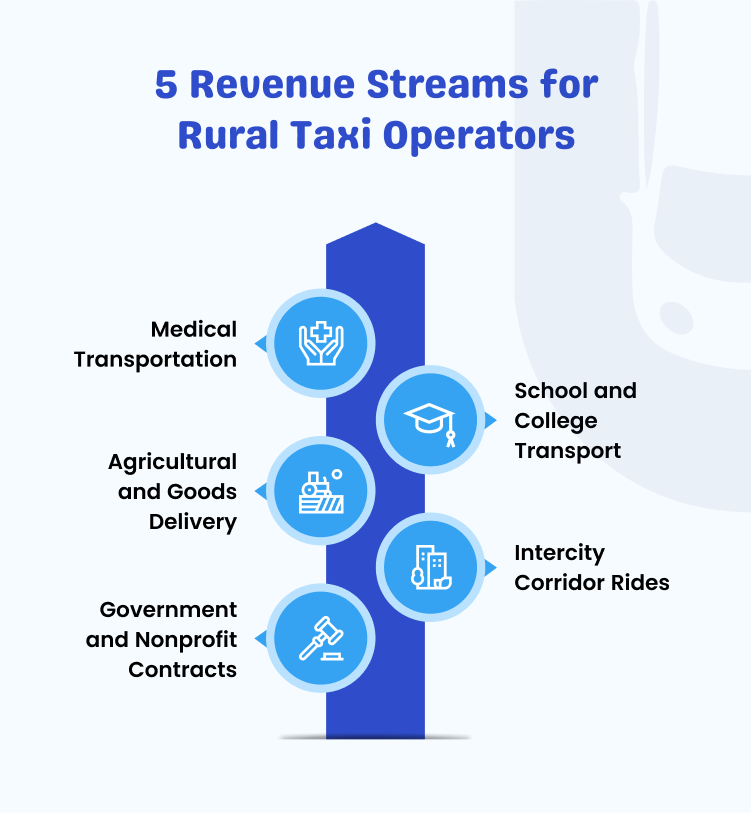
Standard ride-hailing in rural areas generates revenue – but it rarely generates enough on its own in the early stages. The rural taxi operators who build profitable businesses do so by layering multiple revenue streams on top of the same fleet and platform.
Medical Transportation
Non-emergency medical transportation (NEMT) is one of the most reliable revenue streams available to rural taxi operators. Medicaid reimburses NEMT trips for eligible beneficiaries in most US states. Hospitals and clinics often contract directly with local transport providers to ensure patient attendance for appointments.
Medical trips are pre-scheduled, cancellation rates are lower than leisure rides, and the same driver and vehicle can serve multiple patients in a day. This predictability makes NEMT a strong anchor revenue stream from month one.
School and College Transport
Rural school districts often struggle to cover all students within standard bus routes. Contracted taxi services fill these gaps – particularly for students on remote farms or in outlying villages. Contracts are typically term-based, providing consistent daily volume and predictable monthly income.
College towns in rural areas generate additional demand from students who need transport to off-campus jobs, grocery stores, and intercity bus connections.
Agricultural and Goods Delivery
Rural taxi vehicles are often available during the mid-morning and early afternoon – gaps between morning and evening ride demand. This idle capacity can be monetized through small-goods delivery: farm produce to local markets, pharmacy deliveries to homebound residents, and supply runs for rural businesses.
This does not require a separate fleet. The same vehicle and driver, between passenger trips, can generate delivery revenue with no additional fixed cost.
Intercity Corridor Rides
Rural residents regularly need to reach the nearest city – for hospital visits, government services, shopping, and intercity travel connections. Scheduled intercity corridor runs – departing at fixed times, accepting pre-bookings – fill this need while generating significantly higher per-trip revenue than local rides.
A daily morning-and-evening corridor service between a rural town and the nearest city hub can anchor your schedule while generating predictable long-trip income.
Government and Nonprofit Contracts
Federal and state programs fund rural transport for specific populations. The US Rural Transit Assistance Program (RTAP) provides technical assistance and funding to rural transit operators. Many counties and municipalities contract local operators to provide subsidized transport for elderly and disabled residents. Veterans Administration programs fund transport for rural veterans with disabilities.
These contracts provide guaranteed monthly revenue that is not dependent on individual ride bookings – a powerful financial floor for a new rural operator.
Passenger and Driver Features Your Rural Taxi App Must Have
A standard urban ride-hailing app is not designed for rural operations. Rural passengers and drivers face conditions – poor connectivity, long distances, unpaved roads, cash-preferred payments – that require specific platform capabilities. These are not optional enhancements. They are the baseline requirement for an Uber clone app user features set that actually works in the field.
|
Passenger Features |
Driver Features |
|
Pre-booking for scheduled rides hours or days in advance |
Offline mode for connectivity dead zones mid-trip |
|
SMS and call-based booking for low-connectivity or non-smartphone users |
Zone-based dispatch showing nearby demand areas on the map |
|
Cash payment option alongside digital wallets |
AI route optimization for long rural distances |
|
Simple low-data UI optimized for 2G/3G networks |
Pre-scheduled trip calendar with daily itinerary view |
|
Real-time driver tracking with ETA display |
Earnings dashboard with per-trip fuel and distance tracking |
|
Ride pooling and shared-route option for cost-sensitive riders |
Multi-vehicle type support – cars, vans, three-wheelers |
|
Emergency SOS with GPS location sharing |
In-app navigation adapted for rural and unpaved routes |
|
Carbon copy booking confirmation via SMS for offline riders |
Passenger communication via SMS when data is unavailable |
Each of these features directly addresses a real operational scenario in rural ride-hailing. A passenger who cannot get a data signal still needs to book a ride. A driver covering 30 miles of countryside still needs accurate routing. A community rider without a bank card still needs to pay.
How to Choose the Right Platform For On-demand Transportation in Rural Areas?
The platform decision is as important as the market decision. An urban ride-hailing platform forced into a rural context will create operational problems from day one – poor connectivity handling, no pre-scheduling, no cash support, and an interface built for dense urban grids rather than rural road networks.
Why Generic Urban Platforms Fail Rural Operators?
Urban platforms assume persistent internet connectivity, short trip distances, card-based payments, and high ride density. Remove any one of those assumptions, and the platform begins to struggle. Remove all four, and it becomes operationally unviable.
The failure mode is not dramatic. It is incremental: drivers going offline mid-trip with no fallback, riders unable to book when the signal drops, no ability to pre-schedule a medical appointment ride, and no way to accept cash from an elderly passenger without a smartphone.
What to Look for in a Rural-Ready Platform?
- Offline capability – the app must continue functioning with degraded or no connectivity.
- SMS and call-in booking – not every rural rider has a smartphone or stable data.
- Pre-scheduling – rural riders plan trips days in advance, not minutes.
- Cash payment support – essential for unbanked and elderly rider demographics.
- Lightweight UI – optimized for 2G/3G; not dependent on high-bandwidth data loading.
- Multi-vehicle type support – rural fleets use vans, minibusses, and three-wheelers, not just sedans.
- Zone-based dispatch – optimized for low-density geography, not urban grid assumptions.
- Scalability – start with one zone, expand to neighboring areas without re-platforming.
Pre-Built White Label vs. Custom Build
For most rural taxi entrepreneurs, a pre-built white-label platform is the right choice. Custom development for a rural-specific platform requires significant upfront investment, takes months to build, and carries technical risk on top of operational risk.
A whitelabel platform configured for rural operations gets you live in days. Your brand, your pricing, your service zone – on a foundation that has already solved the offline, connectivity, and dispatch challenges you will face. Understand Uber clone app vs. custom taxi app comparison with honest cost and timeline data to make the right decision.
Conclusion: Rural Markets Reward First Movers
The taxi booking service in rural areas is not a niche. It is an underserved market of enormous scale, ignored by major platforms, underfunded by public transit agencies, and actively needed by millions of residents who have no reliable on-demand transportation today.
It is one of the few segments in ride-hailing where an entrepreneur can enter a market with almost no direct competition, a genuine community impact, and multiple revenue streams supporting profitability from an early stage.
In the article, we have discussed a detailed guide on how to launch a taxi booking service in rural areas, going through each step one by one. We understood that you do not need to spend 12 months building technology from scratch. You do not need a team of developers on payroll.
If you are ready to build that business, our Uber clone app is a fully configurable, white-label ride-hailing platform built for a ride-hailing business that can serve any market – urban or rural – and scale on its own terms. The communities that need your service are already there. The riders are waiting. The only thing missing is the operator willing to show up and serve them.
Launch Your Taxi Booking Service In Rural Areas With Our Uber Clone App, Flexible For Any Market