Key Takeaways (or TL;DR)
- Acquiring riders is easy – keeping them is where most taxi platforms fail silently. Therefore, rider retention strategies for your Uber clone is necessary.
- Personalized push notifications and in-app offers are the fastest wins to reduce rider churn in Uber clone.
- A tiered Uber clone loyalty program turns occasional riders into habitual, high-LTV users.
- AI-driven churn prediction lets you act before a rider disappears – not after.
- Gamification (streaks, milestones, leaderboards) boosts ride frequency without raising marketing spend.
- Re-engagement campaigns targeting inactive users can recover 12-15% of at-risk riders.
You spent months launching your Uber clone. Riders downloaded the app, completed their first booking, and left a good rating. But 60 days later, most of them had vanished.
This is the silent killer of ride-hailing platforms. You can acquire riders with promotions and referrals. Retention is a completely different game.
Most operators focus their energy on getting riders in. Very few build systems to keep them. And that gap is exactly where ride-hailing businesses stall or fail.
This guide gives you the full playbook on rider retention strategies for your Uber clone, reduces rider churn with strategic steps such as deploying loyalty programs, and implements AI-driven personalization and re-engagement strategies that actually work.
What is the Churn Rate in the Taxi Business?
The churn rate in the taxi business measures the percentage of riders who stop using your taxi app over a specific period. If you had 1,000 active riders last month and 200 stopped booking, your churn rate is 20%.
In the ride-hailing industry, churn happens fast. Riders often try a platform once or twice, hit a friction point – long wait time, surge pricing, poor experience – and quietly move on.
Here is a simple formula to track it:
Churn Rate = (Riders Lost in Period ÷ Riders at Start of Period) × 100
Monitoring this monthly gives you an early warning system. Always strive to reduce rider churn in Uber clone. A rising churn rate is always a signal, not just a statistic.
Difference Between Churn Rate and Retention Rate in the Taxi Business?
These two metrics are two sides of the same coin. Churn rate tells you how many riders you are losing. Retention rate tells you how many you are keeping.
| Metric | Churn Rate | Retention Rate |
|---|---|---|
| What it measures | Riders you are losing | Riders you are keeping |
| Formula | (Lost ÷ Start) × 100 | (Retained ÷ Start) × 100 |
| Goal | Keep it as low as possible | Keep it as high as possible |
| Business signal | Dissatisfaction or weak engagement | Strong product-market fit |
Both metrics should be tracked together. Churn tells you the problem. Retention rate tells you how well your fixes are working.
Ready To Build A Taxi Platform That Riders Don’t Want To Leave?
Why Rider Churn Is the Real Growth Problem in Ride-Hailing?
Here is the math most operators never do. Acquiring a new rider costs 5-7× more than retaining an existing one. And each retained rider delivers 2.5× higher lifetime profit compared to a new acquisition.
This means every rider you lose is not just lost revenue today; it is a compounding deficit that costs you more to replace than to have kept.
The most dangerous window is the first three rides. Research in the ride-hailing sector consistently shows that riders who complete fewer than three bookings have a dramatically higher probability of churning permanently.
Your platform’s biggest retention lever is not advertising – it is making that third ride happen. Everything in the first 30 days of a rider’s journey should be designed around that goal.
💡 Expert Note
Send a personalized follow-up message after a rider’s first completed trip. A simple ‘Thanks for riding with us – here’s a discount on your next booking’ increases second-ride conversions significantly. Do not wait for them to come back on their own.
Rider Retention Strategies for Uber Clone – Built-in Feature Checklist
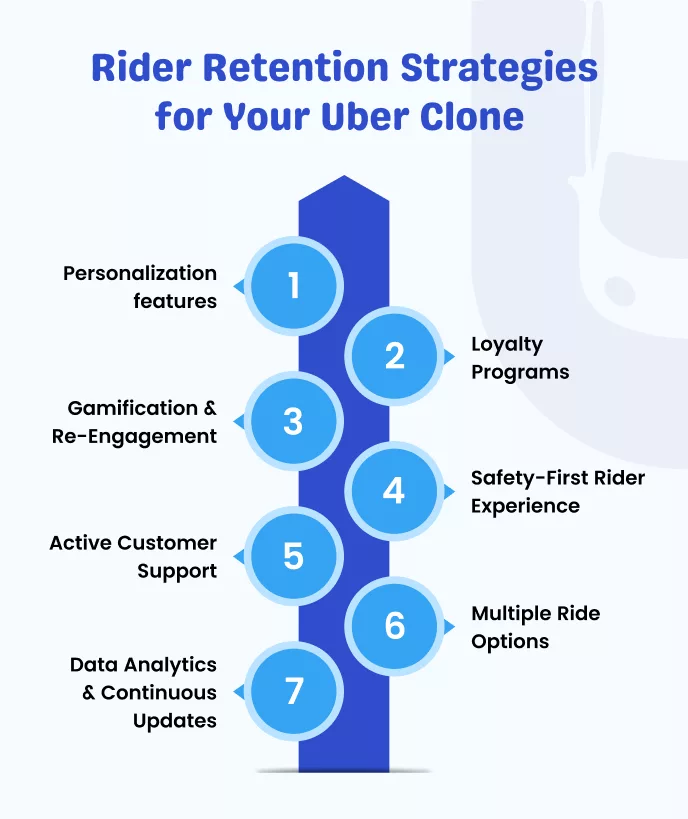
The following rider retention strategies for your Uber clone are not theoretical. Each one maps directly to features built into your app.
1. Personalization – The First Line of Defense Against Churn
Riders do not churn because your service is bad. They churn because your service feels generic. Personalization fixes that.
Start with behavioral segmentation. Your taxi app should automatically classify riders into groups: daily commuters, weekend users, airport travelers, occasional bookers, and dormant users. Each group needs different messaging.
- Frequent riders → reward acknowledgment, loyalty tier upgrades
- Dormant users → win-back offers with time-limited urgency
- New riders → onboarding nudges to complete a third booking
- Late-night users → safety-first messaging and route transparency
Smart push notifications powered by behavioral data dramatically outperform generic blasts. A notification sent at the right moment when a rider is likely heading to work converts at 4-5X the rate of a broadcast message.
AI-powered Uber clone platforms take this further. They detect patterns like low-battery urgency, off-peak availability, or pre-booked airport rides and trigger contextual offers automatically.
According to Gartner research, AI-based personalization is adopted by 51%. The operators who implement behavioral segmentation in year one retain significantly more riders than those who rely on broadcast promotions.
2. Uber Clone Loyalty Program Keeps Your Riders Coming Back
A loyalty program is not a marketing gimmick. It is an infrastructure decision. When riders have points to earn or a tier to protect, switching to a competitor has a real cost.
You have two primary models for your Uber clone loyalty program: points-based and tiered. Here is how they differ in a taxi app context:
- Points-based: Riders earn points per booking, redeemable for discounts or free rides. Simple to understand, easy to build habits around.
- Tiered: Riders progress through Bronze, Silver, Gold levels. Each tier unlocks better perks – priority dispatch, flexible cancellations, fare locks. Tier protection drives frequency.
For early-stage taxi platforms, start with a points-based model. It requires less behavioral data to run effectively and delivers visible value to riders immediately.
The reward mechanics that work best include booking rewards, referral bonuses, in-app payment incentives, and premium service upgrades. Riders who engage with more than one reward type show significantly lower churn rates.
|
🥉 Bronze |
🥈 Silver |
🥇 Gold |
|
0-10 rides/month |
11-25 rides/month |
26+ rides/month |
|
Earn points per ride |
Points + free cancellations |
Points + priority dispatch + fare lock |
Uber One membership grew 60% year over year in 2024. Riders with subscription loyalty programs book more frequently and cancel less. The same dynamic applies to regional taxi platforms; the mechanism is identical.
💡 Expert Note
Do not launch your loyalty program with too many earning categories at once. Riders disengage when the system feels complicated. Start with ride-based points only. Add referral bonuses and payment incentives once your baseline engagement is established – usually after 90 days.
3. Try Gamification and Re-Engagement
Gamification is not about making your taxi app look like a game. It is about using the psychology of progress, achievement, and recognition to keep riders coming back consistently.
The most effective gamification elements for ride-hailing platforms include:
- Ride streaks: Reward riders who book 5 or 7 consecutive days with bonus points or a free ride.
- Milestone celebrations: Mark the 10th, 50th, and 100th ride with in-app recognition and a tangible reward.
- Leaderboards: For commuter-heavy markets, a monthly ‘Top Riders’ leaderboard creates friendly competition and habit reinforcement.
Re-engagement campaigns target riders who have gone dormant, with no bookings in 14-30 days.
The formula that works: a personalized push notification, a time-limited offer (48-72 hours), and a simple one-tap booking path.
Platforms using AI-driven churn prediction can act even earlier. The system identifies behavioral signals, declining booking frequency, fewer app opens, longer time between rides, and flags users as at-risk 7 to 14 days before they fully disengage.
💡 Expert Note
Your win-back offer does not need to be a large discount. Research in the app economy shows that a 10-15% fare discount with a 48-hour urgency window outperforms a 30% flat discount with no deadline. Urgency drives action more than discount size.
4. Offer a Safety-First Rider Experience
Safety is not a feature – it is a retention driver. Riders who feel unsafe after even one trip do not come back. And they tell others.
Your Uber clone should have non-negotiable safety infrastructure built into every booking flow:
- Live GPS tracking is visible to riders and emergency contacts throughout the trip
- SOS button with instant alerts to a designated contact or local emergency services
- In-app masked calling so personal numbers are never shared between drivers and riders
- Real-time driver rating visibility before trip confirmation
- Post-trip safety check-in notifications for late-night rides
Payment security is equally important. Riders who experience payment failures or unauthorized charges churn immediately and permanently. Your platform’s payment infrastructure needs to be airtight.
Build reliable payment flows integrating secure Uber clone app payment gateways – a critical component of rider trust.
💡 Expert Note
Add a ‘Share My Ride’ feature that lets riders send live tracking links to trusted contacts. It costs nothing to build on modern platforms and is consistently rated as one of the top trust-building features by female riders and late-night commuters.
5. Active Customer Support That Resolves Issues Fast
A bad ride experience does not automatically cause churn. A bad ride experience with no resolution does. Support quality is a direct retention variable.
Riders who contact support and receive a resolution within 60 minutes show measurably higher return booking rates than those whose issues go unresolved for 24 hours. Speed matters as much as the outcome.
Your support infrastructure should include:
- In-app chat support with response time targets under 5 minutes for urgent issues
- Automated refund triggers for verified trip problems – no manual review required for small amounts
- Proactive issue detection – if a ride ends significantly off-route, the system flags it automatically
- Post-trip rating follow-up – if a rider gives 1 or 2 stars, trigger an immediate support touchpoint
💡 Expert Note
Set up automated compensation for common friction points before riders complain. A 10-minute wait that exceeds your platform’s ETA guarantee should trigger an automatic credit – without the rider needing to file anything. Proactive recovery builds loyalty faster than reactive support.
6. Offer Diverse Ride Options to Meet Rider Needs
A platform that only offers standard rides is a platform riders will abandon the moment a specific need arises and a competitor meets it.
Rider diversity demands service diversity. Your Uber clone platform should support multiple ride categories:
- Economy rides for cost-conscious daily commuters
- Premium rides for business travelers and high-value occasions
- Scheduled rides for airport trips, medical appointments, and predictable recurring bookings
- Wheelchair-accessible vehicles (WAV) for riders with mobility needs
- Outstation and intercity options for markets where local travel extends beyond city limits
Riders who use more than one service category within your platform have significantly lower churn rates. Each additional service type they adopt deepens their reliance on your platform and raises the cost of switching.
💡 Expert Note
Launch with two or three ride types. Adding too many at launch fragments driver supply and extends wait times, which drives churn. Introduce new categories once your driver pool in each zone can support them without degrading ETA performance.
7. Invest in Data Analytics and Continuous Improvement
You cannot fix what you cannot see. A taxi platform without analytics is operating blind – and blind operators make the same retention mistakes repeatedly.
The key data layers your Uber clone dashboard should surface include:
- Rider cohort analysis: How do riders acquired in Month 1 behave in Month 3 and Month 6?
- Drop-off mapping: Which steps in the booking funnel lose the most riders?
- Driver performance correlation: Are low-rated drivers linked to elevated churn in specific zones?
- Promo attribution: Which discount campaigns actually drove return bookings versus one-time use?
Analytics without action is just expensive data storage. Build a monthly review cadence where you examine your top three churn indicators and assign a corrective action to each.
💡 Expert Note
Use A/B testing on your re-engagement messages before scaling them. Test two versions – different timing, different offer amounts, different copy – on 10% of your dormant cohort each. Scale the winner. Operators who test before scaling reduce wasted promotion spend by 20-40%.
Your Uber Clone Platform Should Have These Retention Tools Built In – Not Patched In Later. Our Uber Clone Offers All
Metrics That Tell You If Your Retention Strategy Is Working
Strategy without measurement is guesswork. These are the metrics that matter for a growing taxi platform and what healthy benchmarks look like.
| Metric | Healthy Target | What It Tells You |
|---|---|---|
| Day-30 Retention Rate | >40% | Are riders coming back after their first month? |
| Monthly Churn Rate | <8% | How fast are you losing riders month-over-month? |
| Ride Frequency (per user/month) | 4-6 rides | Are riders integrating your platform into their routine? |
| Customer LTV | Growing QoQ | Is each rider generating more value over time? |
| Re-engagement Recovery Rate | >12% | How many dormant riders do your campaigns bring back? |
| Support Resolution Time | <60 mins | How fast do you resolve experience issues? |
What does good retention look like over time? At 6 months, a healthy platform retains 35-45% of its acquired riders on a monthly basis. At 12 months, operators with active loyalty programs and personalization infrastructure retain 50-60% of their high-frequency cohort.
These are not aspirational numbers. They are achievable benchmarks for platforms that treat retention as a core business function, not an afterthought.
|
💡 Expert Tip Do not evaluate your retention strategy for 30 days. Most operators make this mistake. Retention compounds slowly – the effects of a loyalty program or re-engagement campaign often show up meaningfully at 90-120 days. Commit to a full quarter before drawing conclusions. |
Build a Taxi Platform That Riders Do Not Want to Leave
Rider churn is not inevitable. It is the predictable result of platforms that prioritize acquisition over experience and features over strategy. The operators who win in ride-hailing are the ones who engineer retention into their platform from day one – not as an add-on, but as a core design principle.
Every rider retention strategy for your Uber clone in this guide, including personalization, loyalty programs, gamification, safety infrastructure, diverse ride options, and data analytics, is built into our Uber clone. You do not need to integrate third-party tools, negotiate enterprise software contracts, or build retention features from scratch. The infrastructure is ready. Your job is to activate it, tune it to your market, and measure it consistently.