Key Takeaways (or TL;DR)
- AI in Uber clone apps enables intelligent automation across ride-hailing platforms, looking to offer sophisticated features at a low operational cost.
- AI can power up an Uber clone app to feature chatbots, intelligent ride-matching algorithms, surge pricing automation, dynamic routing, and more.
- When leveraged properly, AI can turn Uber clone apps more profitable by lowering operational costs and increasing user retention.
- Implementing AI in the Uber clone app is a phased process to avoid costly redos that can significantly affect the platform’s bottom line.
- There will be challenges in terms of data privacy, compliance, model accuracy, and model integration. However, by opting for a ready-to-deploy Uber clone with pre-built AI features, these challenges can be avoided with ease.
New players in the taxi industry are pushing through the competition with aggressive pricing, heavy driver incentives, and low margins. Basic ride-hailing apps are no longer enough to win in this environment. It’s time to go smart with AI in Uber clone app.
AI gives Uber clone models the ability to learn, adapt, and make intelligent decisions across every layer of the business in real time. The intelligent automation can handle matching, pricing, routing, security, and customer experience without manual intervention. However, smart solutions come with complex challenges. This article breaks down everything you need to know about building one, from the features that drive growth to the implementation process that makes it work.
Why AI in Uber Clone Is the Future of Ride-Hailing Apps
AI in Uber clone acts as a central processing layer that automates complex decisions, such as driver matching and fare calculation, using real-time data. AI learns customer behavior and predicts demand spikes in advance to turn the business more profitable.
A decade ago, ride-hailing apps used to be good for just two core functions: GPS tracking and manual dispatching. Then came algorithms for ride matching and surge pricing. Now, the ride-hailing industry runs on machine learning, predictive analytics, and behavioral data. They build the very foundation of how a modern Uber clone operates.
These massive upgrades are shaped by dynamic customer behavior. Nowadays, there are plenty of players in the market. Some offer reasonable fares, some arrive at your door in minutes. Customers want everything exciting from one service provider. This is where AI in Uber clone app really excels.
AI can read demand patterns and adjust pricing based on live traffic, weather, or local events, differently for every city you operate in. Riders meet the nearest available driver in seconds. In case of any query, AI bots handle faster and personalized replies.
According to McKinsey & Company, machine learning in the mobility industry is expected to become a key source of competitive advantage, enabling taxi businesses to optimize operations, improve decision-making, and unlock new value pools.
AI Features in Uber Clone That Drive Business Growth
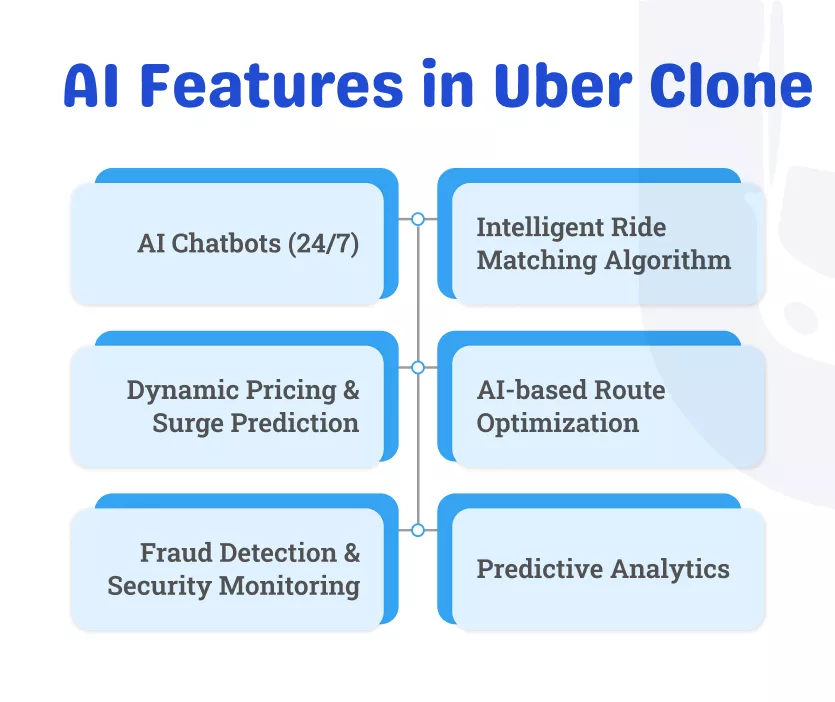
AI should not be considered merely as a data analysis tool. It offers surprisingly advanced features for a ride-hailing platform when you know how to use it effectively. When powered by AI, you can expect to grow your business with these advanced Uber clone features:
AI Chatbots (24/7)
AI chatbots are good at handling common ride disputes at any hour, if programmed properly. They follow a guided conversation flow to answer queries in seconds. This creates a positive user experience, unlike waiting in a queue for human assistance.
Through Natural Language Processing (NLP), AI chatbots can even respond to voice notes with empathy. If customers request a human agent, the bot shares the entire chat history to resolve the issue faster.
Intelligent Ride Matching Algorithm
A basic Uber clone algorithm will match a rider to the nearest driver. However, AI does data-powered, logical matching with the help of machine learning. It factors in driver acceptance rates and rider ratings to create pairings that both sides are likely to confirm.
Based on real-time traffic data, AI gives a precise ETA, far more accurate than a rough estimate. As AI removes frictions that lead to last-minute cancellations, the platform experiences stronger revenue.
Dynamic Pricing & Surge Prediction
Price stands as the most important factor when choosing a ride-hailing service. Static pricing fails drivers during off-peak hours. AI can dynamically lower the price at such moments to drive more bookings. AI can also identify demand spikes early by analyzing local events and weather conditions. The surge price activates at exactly the right moment.
Based on driver availability and rider requests, the system adjusts fares to balance the market. This directly maximizes revenue per hour of platform activity.
AI-based Route Optimization
Every minute of delay in traffic costs the business its customers and money. AI analyzes the entire city’s traffic map at once and highlights bottlenecks in advance for an on-time detour.
The AI-driven backend recalculates routes instantaneously, pushing live navigation updates to drivers through the Uber clone app’s real-time tracking system. The algorithm aims to meet the promised ETA even under such dynamic conditions. More on-time trips mean more earnings per hour for both the driver and the platform.
Fraud Detection & Security Monitoring
The safety of riders and drivers is important in establishing a fraud detection system in a ride-hailing business. AI builds trust for both parties by monitoring every transaction and interaction in real-time. The moment a ghost rider tries to manipulate driver earnings, AI flags the fraudster in seconds. And, it does it continuously at scale.
AI digitally verifies drivers’ identity, questions their unusual route detours, and raises alerts against abnormal login activities. That’s how it keeps the platform safe for everyone.
Predictive Analytics for Business Intelligence
AI helps ride-hailing platforms shift from reactive to predictive decision-making, where serious business growth begins. The app can pre-position drivers in high-demand zones before the surge happens. It is possible as AI can predict a surge by analyzing historical booking data, upcoming local events, seasonal travel patterns, and weather forecasts together.
Predictive analysis can also spot underperforming zones with key reasons, like driver shortage, to make smart decisions quickly. Instead of guessing, the management knows exactly where they should focus.
Initiate to Become an AI-Powered ride-hailing Business With Our Readymade Uber Clone
Key Benefits of AI in Uber Clone for Startups and Enterprises
When you smartly use AI to enhance your Uber clone’s capabilities, your business grows faster with the following benefits.
Increased Operational Efficiency
One of the biggest benefits of AI in Uber clone is that it automates most of the manual operations that are costly and prone to error. For example, drivers automatically receive the coordinates of the start and drop locations immediately after the booking.
Even dynamic adjustments to fares and real-time routing require little to no human involvement. Those automations directly translate to a low operational cost. The saved margins can be used to expand business footprints instead.
Higher Customer Retention Rates
It is more expensive to acquire a new customer than to retain an existing one. AI can auto-execute even the most tedious hacks with perfection to improve customer retention.
AI makes each conversation personal for users with targeted replies powered by their personal data. For example, it can highlight premium vehicles at the top if the rider has frequently travelled with those options before. Such small things skyrocket retention rates to a new, safe level.
Improved Driver Productivity
Drivers often complain about chasing rides across the city. AI can suggest nearby high-demand areas and upcoming surge zones in real-time. The demand forecast helps them plan their shifts around peak opportunities.
Plus, based on their vehicle type, it connects drivers with riders who are less likely to cancel orders. More rides mean more profit and less churn rate than otherwise.
Revenue Growth Through Intelligent Monetization
AI can run smart monetization models to maximize profits, analyzing market conditions. For example, when a new player enters the market, AI can recommend commissions per ride instead of a flat cut to prevent top drivers from leaving the platform.
AI can even retain drivers on different commission tiers. Drivers with the best average ratings pay less platform fee than average drivers. The same intelligence goes into surge price optimization. When demand spikes, AI sets the price that appears fair to both riders and drivers.
How to Implement AI in Uber Clone? It’s a 5-Step Process
Building an AI-powered ride-hailing platform requires a clear process to add the right features with the right business goals from day one.
Market Research and Business Model Finalization
If you don’t know your market, it’s hard to turn even a feature-rich taxi booking app profitable. The market does not necessarily mean a demographic area. It can be service gaps your competitors leave open where you can excel with an AI-powered platform. This research defines your business model.
AI Feature Prioritization
You don’t need to arm your Uber clone app with all possible AI features. It won’t make the app popular overnight. Instead, have features that represent your business model. Any additional AI features in Uber clone should be weighed against the following three questions:
- How can it impact revenue?
- How quickly can it be integrated?
- Can it help acquire new markets?
Your entire decision workflow should be documented and shared amongst teams to make priorities clear for everyone.
Prototype and MVP Development
Before your team moves into full AI model training with confidence, test your ideas with a prototype model. Build a minimum viable product (MVP) using Uber clone app tech stack, along with advanced AI features.
Launch it in a small market and collect user behavior data. At this stage, invest in building clean, real-time data pipelines as they impact AI’s analytical speed.
AI Model Training & Testing
After sufficient data collection in the MVP phase, there comes model training. Now the algorithm is trained to make sense of a successful trip psychology by reverse engineering elements such as:
- Happy trip records
- Driver acceptance patterns
- Cancellation triggers
- Rider feedback scores
Even the dynamic pricing model is trained on demand logs, surge events, and revenue outcomes across different price points. This improves the model’s capacity to decide surge prices that don’t feel unfair to drivers and riders.
Each model runs under a controlled test environment. For example, the pricing model is tested during simulated peak hours with fluctuating driver supply. The route optimization engine is tested through dense traffic scenarios with multiple rerouting triggers.
Any unexpected model behavior gives the team room to figure out how to implement AI in Uber clone without pressure.
Deployment & Continuous Optimization
It is always advisable to launch AI features in a phased manner. Start with a small market segment, learn the gaps, optimize the model, and repeat the cycle. Each optimization should be about new targeted adjustments.
There should be a clean dashboard to monitor the key performance metrics of all AI features at once. It helps the team to identify anomalies and respond immediately. Commit to continuous optimization from day one, and the platform compounds its intelligence advantage with every ride it completes.
Get a Ready-made AI-powered Uber Clone That Helps You Increase Operational Efficiency, Productivity, and Simplified Growth
Challenges in Implementing AI in Uber Clone
The ride-hailing business is indeed profitable when you know how to overcome obstacles strategically rather than reactively. Some of the core challenges and their solutions are discussed below.
Data Privacy and Compliance
AI collects a lot of personal user data for predictive analytics. Platforms are in a safe zone as long as they handle this data within legal and ethical boundaries, under a strong security architecture. However, this becomes challenging when the platform has to undergo multiple architectural changes to meet compliance in different countries with their own compliance rules.
Solution:
Ensure the Uber clone has data privacy built into the architecture from the very first line of code. Prefer customizing the code where AI collects only the necessary user data required for proposed features. Encrypt all personal data in transit and at rest with strict access controls. Above all, give users meaningful control to review, correct, and delete their information.
High Initial Investment
Uber clone app development cost depends on a lot of factors. The infrastructure, talent, and development time needed to train and deploy intelligent systems cost considerably more than launching a basic ride-hailing app. While startups struggle to meet their vision due to budget constraints, large enterprises face scope creep. Investing heavily in AI features that the market is not ready for generates cost without return.
Solution:
Instead of building all AI features at once, proceed in a phased manner. Use the return in the first phase of development to justify the next investment phase. Alternatively, look for white-label AI-powered Uber clone solution providers to reduce upfront costs and dramatically shorten the time to first revenue.
Model Accuracy and Continuous Training
Achieving strong model accuracy from the start is harder than most operators anticipate. The matching algorithm needs thousands of completed trip records to identify reliable patterns. The dynamic pricing model needs exposure to multiple demand cycles before it can forecast surge periods with confidence. Early-stage platforms simply do not have this data volume at launch.
The continuous training requirement adds a permanent operational responsibility that many businesses underestimate. Every market shift, every new driver cohort, and every change in rider behavior creates model drift. A matching algorithm optimized for a two-zone MVP may struggle when the platform expands across an entire city.
Solution:
Establish a model performance monitoring system that tracks accuracy metrics continuously across every AI feature on the platform. Validate model performance after every retraining cycle against the defined accuracy benchmarks before pushing any update to the live environment. Assign clear ownership of data quality within the engineering team so that this responsibility never falls through the organizational gaps.
Integration with Legacy Systems
An existing ride-hailing platform may develop friction when trying to integrate with a modern AI layer. Legacy systems work on fixed logic and static workflows. AI, by contrast, requires real-time data exchange. Their forced interaction may create data compatibility issues, unexpected downtime, and unreliable model performance.
Solution:
Map every data flow, every system dependency, and every point where the AI layer will need to connect with legacy infrastructure. Build API connectors between old and new systems for smooth communication without replacing the legacy infrastructure entirely. Introduce the AI layer into one platform component at a time. Validate performance at each phase before moving to the next.
Conclusion
Utilizing AI in Uber clone app is one of the most impactful decisions a mobility business can make today. AI can smart-upgrade every layer of the platform and strengthen every metric that matters. However, one has to strategically progress beyond challenges around data privacy, investment, model training, and legacy integration.
If you want to enter the ride-hailing market with AI capabilities already built in, our ready-to-deploy Uber clone gives you a powerful head start. The platform comes equipped with intelligent automation, real-time data processing, and the core AI features modern riders and drivers expect from day one. You get enterprise-grade technology without the cost and complexity of building everything from scratch. Contact us today for a live demo and see exactly what the platform can do for your business.