
Key Takeaways (or TL;DR)
- Africa’s ride-hailing market is projected to grow from $2.85 billion in 2024 to $4.28 billion by 2032 – making it one of the fastest-growing mobility markets globally.
- Nigeria, Kenya, South Africa, Ghana, and Egypt are the five highest-opportunity markets to launch Uber clone app in Africa.
- Mobile money (M-Pesa, MTN MoMo, Airtel Money) processed 62.42% of African ride-hailing payments in 2024 – your platform must support it natively.
- Motorcycles dominate with 52.84% of market share – your Uber clone needs multi-vehicle-type support from day one.
- Regulatory requirements differ city by city across Africa – compliance built into your platform from the start saves you costly rebuilds later.
- An Uber clone gives you battle-tested ride-hailing infrastructure you can localize and launch in weeks – without building from scratch.
Africa has over 1.4 billion people, rapidly growing cities, chronically unreliable public transport, and a young smartphone-native population hungry for better mobility options. The opportunity to launch a ride-hailing platform here is not coming – it is already here.
Across Lagos, Nairobi, Accra, Cairo, and Johannesburg, millions of riders rely daily on a combination of informal minibusses, unregulated motorcycle taxis, and overpriced traditional cabs. No dominant local digital platform has claimed the majority of these markets. That gap is where your business belongs.
This guide is the practical founder’s playbook to start ride-hailing business in Africa with Uber clone for launching a ride-hailing business in Africa using an Uber clone. You will learn which markets to prioritize, what features your platform must have, and how to navigate the continent’s unique operational challenges, without the cost and delay of building from scratch.
Why Africa is One of the Most Valuable Ride-Hailing Markets Right Now?
The numbers are hard to ignore. Africa’s ride-hailing market stood at $2.64 billion in 2026 and is projected to reach $3.25 billion by 2031, growing at a CAGR of 5.21%. Among all global regions, Africa and Asia-Pacific are leading ride-hailing growth – Africa posting a 4.25% CAGR, one of the fastest among major regions worldwide.
That figure alone tells the story – a population converting from informal transport to app-based mobility at a scale and pace that creates clear windows for new operators.
Three forces are driving this growth simultaneously:
Urbanization
Africa is urbanizing faster than any other continent. Cities are expanding, congestion is worsening, and traditional transport systems – minibusses, informal taxis – cannot scale to meet the demand.
Digital Adoption
Smartphone penetration is rising sharply, fueled by affordable Android devices and expanding 4G coverage. Gen Z and Millennial populations, who make up the majority of Africa’s urban workforce, are comfortable booking services digitally.
Market Fragmentation
In most African cities outside of the largest metros, there is no dominant ride-hailing platform. The informal transport sector still controls the majority of daily trips. This is not a saturated market; it is an open one.
Mobile money has reshaped the payment landscape. According to GSMA’s Mobile Economy report, mobile money transactions already drive 69% of digital commerce in Sub-Saharan Africa, creating a ready, cashless-capable user base for ride-hailing platforms that support the right payment methods.
Top 5 African Countries to Launch Uber Clone App
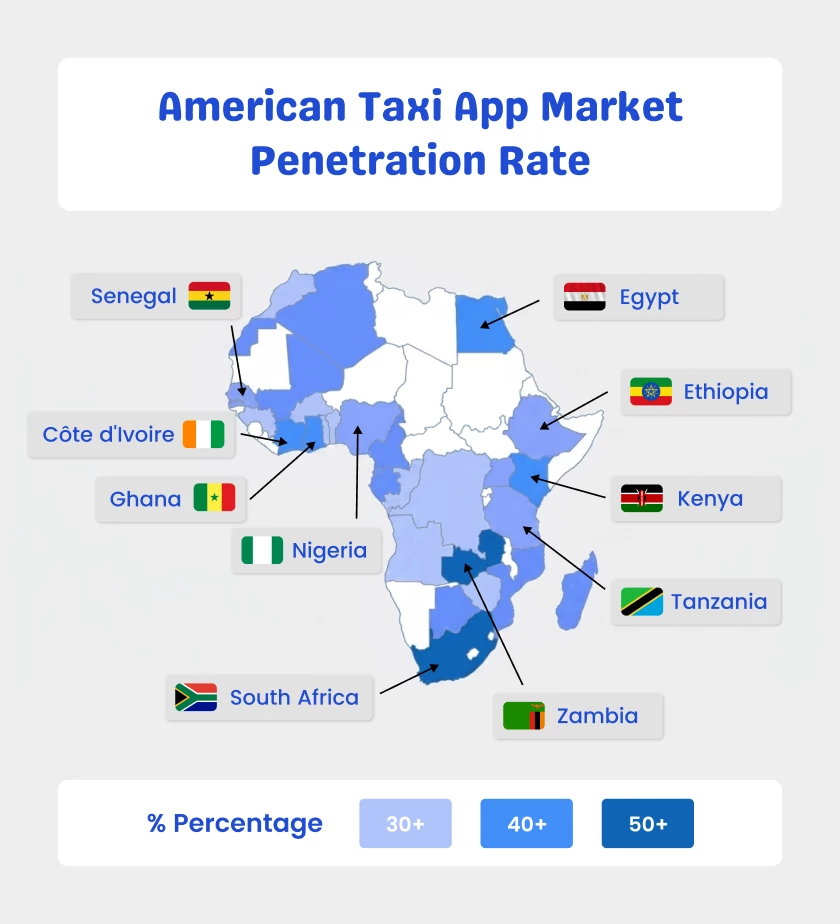
Africa is not a single market. Each country, often each city, has distinct demand patterns, payment infrastructure, regulatory frameworks, and competitive dynamics. These five countries represent the highest-opportunity entry points for a new ride-hailing platform in 2025 and beyond.
Nigeria – West Africa’s Largest Urban Market
Lagos and Abuja are two of Africa’s most congested, high-demand cities. Lagos alone is home to over 15 million people, and its transport infrastructure has not kept pace with population growth. Ride demand is extremely high, and app-based services that offer reliability, safety, and transparent pricing have a ready audience.
Nigeria has a large, tech-savvy urban population with strong smartphone penetration. The fintech ecosystem is sophisticated. OPay and Flutterwave have significantly driven digital payment adoption. Lagos formally introduced ride-hailing regulations in 2025, which created a clearer compliance path for new operators entering the market.
Kenya – East Africa’s Digital Mobility Leader
Nairobi is one of Africa’s most mature ride-hailing markets. M-Pesa, Kenya’s dominant mobile money platform, is so deeply embedded in daily transactions that operating without it is not viable. Your Uber clone must integrate M-Pesa natively, not as an optional add-on.
An Uber clone with strong multi-vehicle-type support, specifically motorcycle ride configuration, is an immediate competitive advantage in this market. Kenya’s fintech and digital infrastructure are among the most advanced on the continent, accelerating rider onboarding and driver payment settlement.
South Africa – Most Mature Market, Premium Segment Opportunity
South Africa’s ride-hailing market is the most developed on the continent and is projected to reach USD 2.94 billion by 2033, growing at a CAGR of 10.83% from 2025 to 2033. – significantly higher than other African markets. Johannesburg and Cape Town have riders with established expectations around service quality, safety, and reliability.
Uber and Bolt are both active and competitive here, which raises the entry bar. However, local operators who understand community-level dynamics, offer driver-friendly commission structures, and price competitively can carve out a strong position in specific city zones. Card and digital wallet penetration is strong, making payment integration simpler than in other African markets.
Ghana – Underserved and Fast-Growing
Accra is a city where demand for reliable, app-based transport is growing faster than supply. Competition among ride-hailing platforms is significantly lower than in Nigeria or South Africa, creating a clearer path to market density for a new entrant. MTN Mobile Money dominates digital payments – integration is essential and straightforward on a modern Uber clone platform.
Ghana’s regulatory environment is comparatively more predictable for new mobility operators, reducing the compliance complexity that characterizes some other African markets. For a startup looking for a strong, manageable first market in West Africa, Accra offers a compelling entry point.
Egypt – North Africa’s Gateway
Cairo is one of Africa’s largest cities by population, with a congestion problem that has driven high adoption of app-based ride services. Uber holds the leading position in Egypt, which actually validates the market rather than closing it. Where a global platform has educated consumers to use ride-hailing apps, the market is primed for competition on price, service quality, and local relevance.
Egypt’s government is actively promoting electric vehicle adoption, with a 2024 pilot of electric taxis in the New Administrative Capital. Operators who plan fleet electrification early can position themselves for regulatory advantages as the EV policy framework matures.
| Country | Key Cities | Market Maturity | Primary Payment Method |
|---|---|---|---|
| Nigeria | Lagos, Abuja | High – Growing | Cash + Mobile Money (OPay, Flutterwave) |
| Kenya | Nairobi | Mature | M-Pesa (dominant) |
| South Africa | Johannesburg, Cape Town | Most Mature | Cards + Digital Wallets |
| Ghana | Accra | Emerging | MTN MoMo (dominant) |
| Egypt | Cairo | Growing | Cash + Cards |
💡 Expert Note
Do not try to launch across all five markets simultaneously. Pick one city in one country – master the local dynamics, achieve market density in a defined zone, then expand. Platforms that attempt multi-country launches at an early stage almost always face driver supply shortages and support quality breakdowns that kill rider trust before retention can be established.
Legal Compliance Checklist Before You Launch Uber Clone App in Africa
| Requirement | Nigeria (Lagos) | Kenya | South Africa | Ghana | Egypt |
|---|---|---|---|---|---|
| Business Entity Registration | CAC | Registrar of Companies | CIPC | Registrar General | GAFI |
| Platform/Operator Licence | Lagos MOT | NTSA | NPTR | DVLA + GRA | ERTA |
| Driver Background Check | ✅ Required | ✅ Required | ✅ Required (criminal) | ✅ Required | ✅ Required |
| Vehicle Age Limit | < 3 years old | 2017+ (2025 rule) | Roadworthy standard | Registered with DVLA | ERTA standard |
| Commission Cap | None stated | 18% maximum | Under review | None stated | None stated |
| Driver Income Tax | Via platform | Digital marketplace tax | SARS | VIT quarterly | ERTA/Tax Authority |
| Platform Service Tax | 10% per transaction | 1.5% digital service tax | VAT 15% | VIT + VAT | VAT |
| Data Protection Law | NDPR 2019 | DPA 2019 | POPIA | DPA 2012 | PDPL 2020 |
Step-by-Step: How to Start Ride-Hailing Business in Africa With Uber Clone
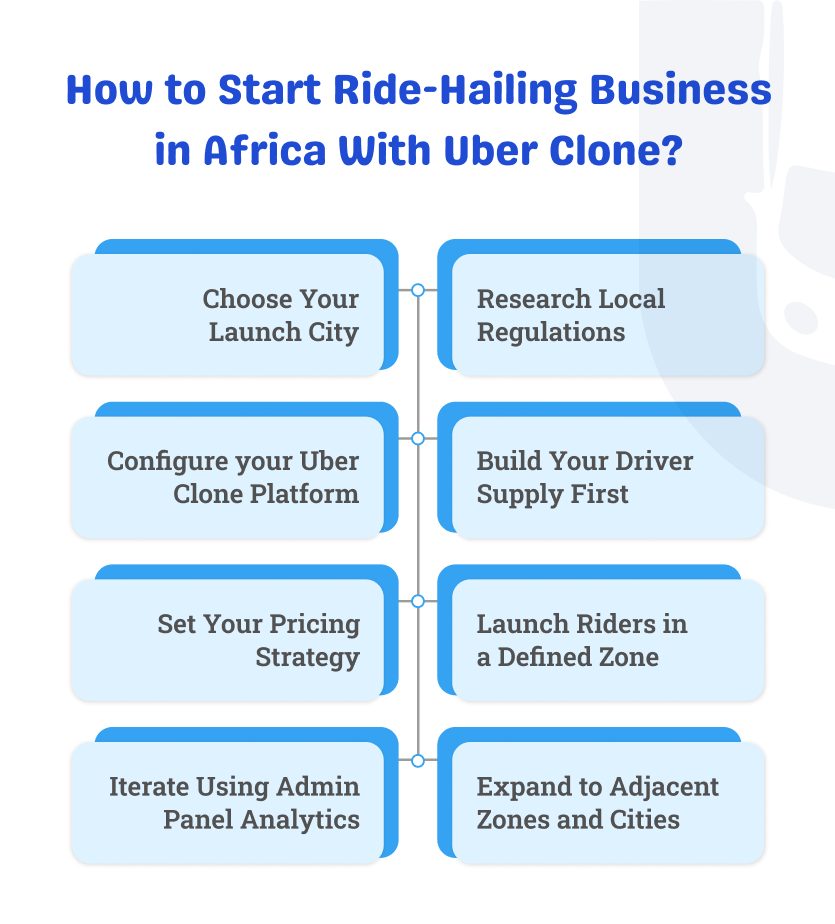
A market opportunity only converts into a business when you execute methodically. Here are the eight steps to start ride-hailing business in Africa with Uber clone that gives your platform the best chance of achieving sustainable density in your first city.
1. Choose Your Launch City
One city, one market, maximum focus. Define a specific zone within that city – not the entire metro – as your launch zone. Urban density in a single district is more valuable than thin coverage across a city.
2. Research Local Regulations
Before you configure a single feature, understand your local region’s requirements for a ride-hailing business. Transport licensing, driver eligibility, vehicle insurance, fare cap rules, and tax registration requirements all vary by city and country. Besides, go through Uber clone legal requirements to understand formal requirements, licenses, and compliance measures that any new startup must meet in order to safely operate.
3. Configure your Uber Clone Platform
Choose to partner with the right tech team and tech suite to build an Uber clone app that is customized to your brand and business strategy. Set up your white-label branding, vehicle types, base fares, payment gateway integrations, and language settings. A properly configured Uber clone admin panel handles all of this without requiring development – pure configuration from a dashboard.
4. Build Your Driver Supply First
Onboard 50-100 active drivers in your launch zone before acquiring a single rider. Use early-stage incentives: low commission rates (15-20% vs. the industry standard 25-30%), referral bonuses for drivers who recruit other drivers, and fast mobile money payouts after every completed trip.
5. Set Your Pricing Strategy
Calibrate your base fare to local income levels and competitive benchmarks. A fare that feels reasonable in Johannesburg may feel prohibitive in Accra. Configure surge pricing for peak windows – morning and evening commutes, major events, and weather-driven demand spikes.
6. Launch Riders in a Defined Zone
Go deep in your chosen district before expanding city-wide. Achieving 15-minute or better wait times in your launch zone is more valuable than covering a larger area with 40-minute waits. Density drives retention; coverage without density drives churn.
7. Iterate Using Admin Panel Analytics
Your platform’s demand heatmaps, driver performance data, booking acceptance rates, and churn metrics tell you exactly where your operation is healthy and where it needs intervention. Review these weekly in your first three months.
8. Expand to Adjacent Zones and Cities
Once your launch zone shows consistent ride frequency, acceptable wait times, and positive rider ratings, replicate the model in the next zone – then the next city. Each expansion builds on the playbook you proved in the first zone.
💡 Expert Note
Build driver supply before you launch to riders. The most common African ride-hailing launch failure is going rider-first – marketing draws users in, but drivers are not available, first-booking wait times are 30+ minutes, and riders never return. The benchmark: 50+ active, vetted drivers with the app installed and available in your launch zone before your first public rider campaign.
Must-Have Features in Your Uber Clone for the African Market
A generic ride-hailing platform is not Africa-ready. First, it should have all necessary features, and then those that make your platform user-friendly for the African market. The features that matter here are shaped by infrastructure realities, payment behavior, safety expectations, and vehicle type diversity that differ significantly from Western markets.
1. Multi-Vehicle Type Support
Motorcycles account for 52.84% of Africa’s ride-hailing market – not as a niche category, but as the dominant service type in most cities outside of South Africa. Your Uber clone must support motorcycle taxis, tuk-tuks, standard four-door cars, and mini-vans – all configurable from a single admin panel without separate apps.
2. Mobile Money and Cash Payment Integration
This is non-negotiable. M-Pesa (Kenya, Tanzania), MTN MoMo (Nigeria, Ghana, Uganda), and Airtel Money (East and Central Africa) together processed 62.42% of ride-hailing transactions on the continent in 2024. Your platform needs native integration with these systems – not a workaround redirect to an external payment site. Alongside mobile money, cash payment support remains essential outside urban cores.
3. Multi-Language and Multi-Currency Support
Africa has over 2,000 languages. Your platform does not need to support all of them – but it must support dominant languages in your target market. Swahili in East Africa, Hausa and Yoruba in Nigeria, French in West and Central Africa, Arabic in Egypt and North Africa, Amharic in Ethiopia, Zulu and Xhosa in South Africa. Multi-currency support becomes critical as you expand beyond your first country.
4. Offline and Low-Data Mode
4G coverage is reliable in major African city centers – but becomes inconsistent in peri-urban zones, informal settlements, and secondary cities where significant rider and driver populations live. Your booking flow must work on 2G and 3G connections. Driver apps must function with intermittent connectivity, caching trip data locally until a connection is restored. Platforms built for high-bandwidth markets fail in exactly the zones where African ride-hailing growth is happening.
5. Safety Features Built for African Urban Realities
Safety is a primary purchase driver in African ride-hailing markets, particularly for female riders and late-night travel. Your platform must include an SOS button with integration to local emergency contacts or services, real-time ride-sharing capability so riders can send live trip details to trusted contacts, and a digital driver verification system with document upload, background check tracking, and admin review workflow.
6. AI-Powered Dispatch and Surge Pricing
One of the important ones is that AI-powered dispatch reduces driver idle time and rider wait times simultaneously. Route optimization adapted to local road networks (including unpaved roads and non-standard street layouts common across African cities) is a significant operational advantage. Surge pricing for peak-hour and event-driven demand captures revenue that flat-fare platforms leave on the table.
| Feature | Why It Matters for Africa | Priority |
|---|---|---|
| Multi-Vehicle Type Support | Motorcycles dominate (52.84%) – must support bikes, tuk-tuks, cars, vans | ✅ Must-Have |
| Mobile Money Integration | 62.42% of payments via mobile money – M-Pesa, MTN MoMo, Airtel Money | ✅ Must-Have |
| Cash Payment Option | Significant cash volume outside urban cores – cannot be card-only | ✅ Must-Have |
| Multi-Language Support | Swahili, Hausa, French, Arabic, Amharic – serve your target market natively | ✅ Must-Have |
| Multi-Currency Support | Essential for cross-border and multi-city expansion | ✅ Must-Have |
| Offline / Low-Data Mode | 2G/3G coverage common outside city centers – booking must work on slow networks | ✅ Must-Have |
| SOS Button + Emergency Integration | High crime rates in some cities – safety features build trust fast | ✅ Must-Have |
| Driver Document Verification | Digital upload + admin review – required for regulatory compliance | ✅ Must-Have |
| AI Dispatch + Route Optimization | Adapts to local road networks; reduces idle time and cancellations | ⭐ Recommended |
| Surge Pricing Engine | Captures peak-hour revenue; attracts drivers during demand spikes | ⭐ Recommended |
| In-App Wallet | Reduces cash handling friction; enables loyalty rewards and promos | ⭐ Recommended |
Want to See All Africa-Ready Features on a Live Uber Clone App? Reach Us
Key Challenges to Launch Uber Clone App in Africa
Every market with this much upside comes with real operational complexity. Here are the five challenges that derail most African ride-hailing launches and the platform-level solutions that resolve them.
1. Fragmented and Evolving Regulations
There is no single African regulatory framework for ride-hailing. Lagos has different rules from Nairobi. Accra has different rules from Cairo. Within countries, city-level regulations vary further. Licensing requirements, driver background check standards, vehicle insurance mandates, and fare cap rules all differ – and they change as governments formalize previously informal transport sectors.
The African Union’s Startup Model Law is creating some framework consistency, and Lagos introduced formal ride-hailing regulations in 2025 – both positive signals. But compliance remains operator-led. The solution is a platform admin panel with per-city compliance configuration: different driver document requirements, different fare structures, and different vehicle type rules per market – all manageable from one dashboard without a development sprint.
2. Payment Infrastructure – Beyond Cards
Card payment penetration remains low in most African markets outside South Africa. Building a ride-hailing platform that requires a credit or debit card at checkout is building a product for a minority of your target riders. Mobile money processed 62.42% of African ride-hailing transactions in 2024. Cash payment volumes remain substantial outside city centers.
The solution is native mobile money integration – not a redirect, not a workaround. M-Pesa, MTN MoMo, and Airtel Money APIs must be built into your payment infrastructure from day one. Include a cash payment option with driver settlement via mobile money at trip end. This combination covers the full spectrum of African rider payment behavior.
3. Low Smartphone Penetration in Tier-2 Cities
Smartphone adoption is growing rapidly across Africa, but it is uneven. In tier-2 cities and peri-urban zones where your next wave of growth will come from, a significant portion of potential riders use basic Android devices on 2G or 3G data. Apps optimized for flagship smartphones fail in these environments.
The solution is a lightweight rider app – sub-20MB installation size, minimal data consumption per booking, and a booking flow that completes in under 60 seconds on a slow connection. USSD-based booking fallback (enabling trip booking via feature phone text messaging) extends your addressable market further into areas where smartphones remain scarce.
4. Driver Supply and Trust
Globally, more than 35% of ride-hailing drivers switch platforms or exit the workforce annually. In Africa, the challenge is compounded by informal transport operators who are skeptical of digital platforms – particularly around commission structures, payment timing, and data ownership.
The solution is a driver-first onboarding experience: low early-stage commission rates (15-20%), transparent earnings dashboards that show drivers exactly what they earn per trip and what the platform deducts, and fast payouts via mobile money – ideally same-day or within 24 hours of trip completion. Drivers who trust the payment process stay on the platform. Drivers who feel exploited leave – and tell other drivers why.
5. Infrastructure Gaps – Roads, Connectivity, and Vehicle Variety
GPS accuracy degrades in dense informal settlements with inconsistent street naming. Road quality varies dramatically within a single city; routes that are viable for a sedan are impassable for some vehicle configurations. Mobile data connectivity drops in specific zones. These are not hypothetical risks – they are daily operational realities.
The solution is vehicle type flexibility at the platform level, route optimization that accounts for road surface and congestion data rather than just map distance, and driver apps engineered for low-bandwidth environments. Your Uber clone should support motorcycle configuration specifically, since two-wheelers navigate congestion and road quality variance far more effectively than four-wheeled vehicles in most African urban environments.
💡 Expert Note
Payment infrastructure is your biggest operational risk at scale in Africa. Build mobile money support in from day one – not as an afterthought integration six months post-launch. Platforms that launch with card-only or cash-only payment in mobile-money-dominant markets face adoption barriers that no amount of marketing spend can fix. The payment method your riders use is the payment method your platform must support on day one.
Why an Uber Clone is the Right Choice Over Building an App from Scratch?
Every entrepreneur evaluating a ride-hailing launch faces the same foundational decision: build a custom platform or use a proven Uber clone. In the African market specifically, this decision has a clear answer – and the data behind it is not ambiguous.
Custom ride-hailing app development takes 12 to 18 months at a minimum. Total build costs range from $80,000 to $200,000 or more, depending on complexity, technical team, and market-specific requirements. And those are the launch costs – not the operational costs that follow.
The harder problem is scale. Analysis of African ride-hailing deployments consistently shows that platforms built on lightweight custom code perform adequately at 1,000 rides per day. At 15,000 to 25,000 daily rides, the architecture breaks – payment mismatches escalate, driver settlement disputes increase, and database performance degrades.
The rebuild that follows typically costs three to five times the original build investment. This is the build-from-scratch trap that has ended multiple promising African ride-hailing startups.
An Uber clone solves this from the start. Production-tested infrastructure, proven at scale, white-labelled with your brand and configured for your market – ready to launch in two to six weeks for a fraction of the custom development cost.
| Factor | Build from Scratch | Uber Clone |
|---|---|---|
| Time to Launch | 12-18 months (minimum) | 2-6 weeks |
| Cost | $80,000-$200,000+ | $5,000-$15,000 |
| Technical Risk | High – rebuilds are common at scale (3-5× overrun) | Low – proven at scale |
| Localization | Requires custom development for each market | Admin panel configuration per city |
| Africa-Readiness | Depends entirely on the build quality | Multi-payment, multi-language, multi-vehicle built in |
| Speed Advantage | A competitor may dominate your city before launch | First mover advantage preserved |
Speed to market compounds in ride-hailing. The operator who achieves density in an underserved African city first sets the competitive baseline – rider habits form, driver livelihoods depend on the platform, and switching costs for both sides rise. The operator who spends 14 months building a custom app may arrive to find a well-configured Uber clone already entrenched in their target zone.
Ready To Launch Uber Clone App in Africa Without the Build Risk?
Your Africa Ride-Hailing Business Starts with the Right Platform
Africa’s ride-hailing market is not a future opportunity. It is a present one – growing at 11.89% annually, underpenetrated in most cities, and hungry for operators who show up with the right product, the right payment infrastructure, and the right commitment to local relevance. The window for first-mover advantage in dozens of African cities is still open. It will not stay open indefinitely.
Everything you need to start ride-hailing business in Africa with Uber clone- configured to your market, branded to your business, ready in weeks. It is built for this. Multi-vehicle support from day one. Native mobile money integration for M-Pesa, MTN MoMo, and Airtel Money. Multi-language, multi-currency, and low-data-optimized operations. Admin-configurable compliance settings per city. AI-powered dispatch adapted to local road networks. Surge pricing that protects your revenue during peak demand.
Start your Africa launch with our Uber clone app and talk to a team that has helped operators across emerging markets go from idea to live platform.