Key Takeaways (or TL;DR)
- The fleet model means you own the vehicles and manage drivers directly – giving you full operational control.
- The aggregator model connects independent drivers to riders through your platform – keeping your investment lean.
- Your city size, capital availability, and growth timeline are the three factors that shape this decision most.
- Fleet-owned Uber clone app suits operators who want to deliver consistent, branded service quality.
- The Uber clone aggregator business model works best for entrepreneurs who want to scale fast across markets.
- The right platform must support your chosen model from day one – or it will cost you later.
If you’re planning to launch a ride-hailing service, you’ve likely already asked: Should I own vehicles or connect independent drivers? That question is at the core of every serious ride-hailing business plan today.
Both models – fleet and aggregator – have room to win. But they don’t win for the same operators, in the same markets, with the same resources.
This blog breaks down the Uber clone fleet model vs aggregator model in plain terms. You’ll understand how each model works, what it costs, and which one fits your business reality. By the end, you’ll have a clear decision framework – not just theory.
What is the Fleet Model in a Ride-Hailing Business?
The fleet model is the traditional approach to running a taxi or ride-hailing business.
You own or lease the vehicles. You recruit, train, and manage the drivers. Every car on your platform belongs to your operation – and every driver works under your direct oversight.
In this model, you’re not just a tech platform. You’re a full transportation operator running both the software and the supply side of the business.
How the Fleet-Owned Uber Clone App Works?
- You acquire a fleet of vehicles (owned, leased, or financed).
- Drivers are hired as employees or on structured contracts.
- Rides are dispatched through your platform, which you control entirely.
- Revenue comes from every trip completed by your fleet.
- Maintenance, insurance, and driver costs sit with you.
Traditional cab companies making the digital transition typically use this approach. They already have vehicles. They already have drivers. Adding a fleet-owned Uber clone app puts their existing operation on a digital platform – without changing the underlying model.
This approach also works well in regulated transport markets where authorities require licensed, identifiable vehicles and employed drivers. Cities with strong taxi unions or medallion systems often favor fleet-based digital operators.
Expert Tip:
One mistake I see fleet operators make repeatedly is launching with too many vehicles too soon. Start with 15–20 well-maintained cars in your highest-demand zones. Prove your dispatch efficiency and driver retention first. Scaling a broken operation just multiplies the problem.
What is the Aggregator Model – and How Does It Work?
The aggregator model is the approach that made Uber’s business model a success.
You don’t own any vehicles. You don’t employ drivers. Instead, your platform acts as the marketplace – connecting independent driver-partners with riders who need a trip.
How the Uber Clone Aggregator Business Model Works?
- Independent drivers register on your platform with their own vehicles.
- Riders book trips through your app.
- Your platform handles dispatch, payment, and communication.
- You earn a commission on each completed trip – typically 15% to 30%.
- Operational costs stay with the driver: fuel, maintenance, and insurance.
The asset-light structure is what made this model dominate globally. Uber scaled to 70+ countries without owning a single vehicle. Grab became Southeast Asia’s largest ride-hailing platform by onboarding independent drivers rather than building a fleet.
This model grows as your driver network grows. The more drivers you onboard, the more supply you have – without proportionally increasing your costs.
Expert Tip:
Driver onboarding speed is the silent killer of aggregator launches. Most new operators obsess over the rider app – and forget that without 50–80 active drivers in a city, your wait times will destroy your reputation before word-of-mouth can save it. Build your driver supply before you open to riders.
Uber Clone Fleet Model vs Aggregator Model: A Head-to-Head Comparison
The global ride-hailing market was valued at USD 178.53 billion in 2026 and is projected to reach USD 252.14 billion by 2030, growing at a CAGR of nearly 8%. It would be hard to decide which model suits this huge market best. Although both offer significant opportunities for you to win.
Understanding both models in isolation is useful. Seeing them side by side is where the decision becomes clear.
| Criteria | Fleet Model | Aggregator Model |
|---|---|---|
| Capital Investment | High – vehicles, insurance, maintenance | Low – platform and marketing only |
| Scalability | Limited by capital and vehicle acquisition | Fast – scales with driver onboarding |
| Driver Control | Fully employed or contracted | Limited – driver partners work independently |
| Service Consistency | High – you set and enforce standards | Variable – depends on individual drivers |
| Revenue Model | Per-trip revenue on all rides | Commission per trip (15–30% typically) |
| Operational Risk | Higher – you carry asset and labor risk | Lower – risk distributed across drivers |
| Best For | Operators with capital, wanting brand control | Entrepreneurs wanting rapid market expansion |
The comparison makes one thing clear: neither model is universally better. They serve different operators at different stages with different resources and goals.
Expert Tip:
The comparison table above looks clean on paper. In the field, the biggest wildcard is always regulation. I’ve seen operators choose the aggregator model based purely on capital efficiency – only to find their city legally requires employed drivers and commercial vehicle licensing. Always validate your model choice against local transport law before you write a single line of code or sign a lease
Yet Not Sure Which Model Fits Your City and Budget? We Help Ride-hailing Entrepreneurs Pick the Right Operational Model.
Pros and Cons of Each Model for Taxi Entrepreneurs
Knowing what’s on the comparison table is step one. Understanding the lived experience of operating each model is what actually prepares you.
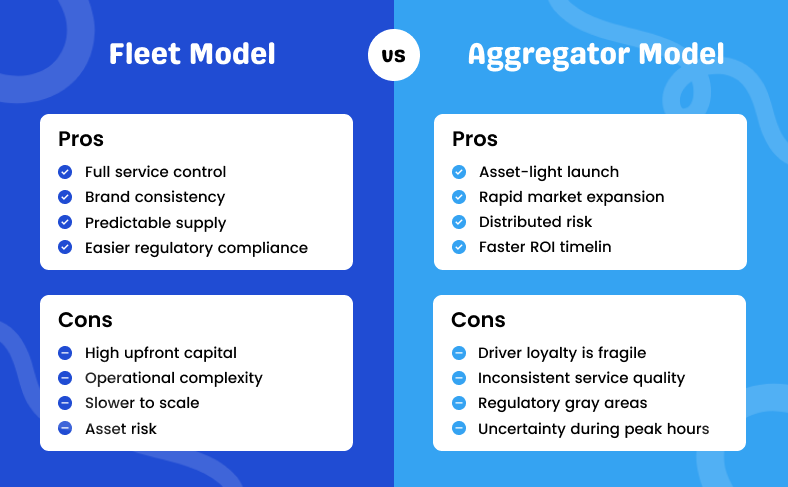
Fleet Model – Pros and Cons
Pros:
- Full service control. You set driver behavior standards, vehicle condition requirements, and customer experience benchmarks. If something goes wrong, you can fix it directly.
- Brand consistency. Every vehicle, every driver, every ride reflects your brand. This matters enormously in premium or corporate ride-hailing niches.
- Predictable supply. You always know exactly how many vehicles are available. You’re not dependent on driver availability or mood on a given day.
- Easier regulatory compliance. In markets with strict transport licensing, an employed-driver fleet model often meets legal requirements more cleanly.
Cons:
- High upfront capital. Acquiring or leasing even 20–30 vehicles requires significant investment before your first ride is completed.
- Operational complexity. You’re managing a transport company, not just a tech platform. That means HR, maintenance scheduling, insurance, and compliance all fall on you.
- Slower to scale. Adding 100 more vehicles takes months and capital. Adding 100 driver-partners on an aggregator platform takes days.
- Asset risk. If demand drops or a market turns competitive, you still own (or owe payments on) the vehicles.
Aggregator Model – Pros and Cons
Pros:
- Asset-light launch. You can go live with minimal capital compared to the fleet model. Your main investments are the platform and driver onboarding.
- Rapid market expansion. You can enter new cities by recruiting drivers – no logistics infrastructure required.
- Distributed risk. Fuel costs, maintenance, and vehicle depreciation stay with the driver. Your cost base stays lean.
- Faster ROI timeline. With lower upfront costs, you can reach profitability faster – especially in high-demand markets.
Cons:
- Driver loyalty is fragile. Independent drivers can work across multiple platforms simultaneously. Retaining your best drivers requires ongoing incentive programs.
- Inconsistent service quality. Without direct control over drivers, customer experience can vary significantly between rides.
- Regulatory gray areas. In some markets, governments are actively tightening rules around driver classification and platform liability. This creates compliance risk.
- Supply uncertainty during peak hours. If drivers log off during high-demand periods, you face a surge without the supply to meet it.
Already running a taxi fleet and thinking about going digital?
See how the Uber clone platform helps you digitize your existing fleet without rebuilding your operations from scratch.
Which Model Should You Choose? A Decision Framework
There’s no universal right answer. But there are clear signals that point you toward one model over the other.
Ask yourself these four questions before you decide:
1. How much capital can you deploy at launch?
You should know the Uber clone cost before knowing anything. If you have significant funding – whether from personal investment, a loan, or investors – the fleet model becomes viable. If you’re launching lean and want to prove the market before committing capital, start an aggregator.
2. How important is service quality consistency to your target market?
Premium corporate ride-hailing, airport transfers, and healthcare transport all require consistent, predictable service. The fleet model delivers that. General urban commuter mobility is more tolerant of variability – aggregators work well there.
3. How fast do you need to scale?
If your business plan requires city-wide or multi-city coverage within 12–18 months, the aggregator model is the only realistic path. Fleet expansion at that speed requires capital most operators don’t have.
4. What does your local regulatory environment require?
Research your city’s transport licensing laws before you choose. Some markets actively encourage platform-based aggregators. Others require employed drivers and licensed commercial vehicles. Your model choice may be partially determined by regulation.
What about a hybrid approach?
Some operators start with a small owned fleet to control quality and build brand trust – then layer in independent driver-partners as they grow. This hybrid approach gives you quality control at launch and scalability over time.
The platform you choose needs to support this from day one. Not all Uber clone apps are built to handle both models. Make sure yours is.
Your Choose Model With Elluminati’s Uber Clone Platform
Choosing between the Uber clone fleet model vs aggregator model isn’t just a strategic decision – it’s the foundation your entire business is built on. Get it right, and your platform, your team, and your growth strategy all pull in the same direction. Get it wrong, and even a well-funded, well-marketed launch struggles to find its footing.
We’ve worked with taxi entrepreneurs at every stage – from first-time operators planning their launch to established fleet owners making the digital leap. Our Uber clone is purpose-built to support both the fleet-owned Uber clone app model and the Uber clone aggregator business model. Whether you’re starting small with 10 vehicles or onboarding 500 independent driver-partners across three cities, the platform grows with you.
If you’re serious about building a ride-hailing business that works – not just an app, but a real operation with real riders and real revenue – you need more than software. You need a platform partner who understands the business. Talk to our team, explore your model options, and launch with confidence.
Expert Tip:
One thing I always tell operators before they sign off on a platform: ask your vendor two questions.
First, can this platform support both fleet and aggregator models simultaneously?
Second, how many real fleet-to-aggregator transitions have they actually supported – not in demos, but in live markets?
The answers will tell you everything you need to know about whether they’re a true platform partner or just a software vendor.