
Key Takeaways (or TL;DR)
- Surge pricing is not just a revenue stream. It is a supply-and-demand balancing tool that keeps rides available during peak demand.
- The Uber clone dynamic pricing algorithm checks demand vs. supply in each geo-zone and multiplies the base fare automatically.
- Surge pricing increases driver earnings during peak hours, which directly improves your fleet availability in real time.
- Transparent surge notifications shown before booking build rider trust – hidden surges destroy it.
- Your admin panel gives you full control: set multiplier caps, define trigger thresholds, and apply rules by zone, time, or event.
- Smart operators combine surge pricing with fixed-fare and pre-booking options to serve all rider types without alienating price-sensitive users.
Your platform has 40 drivers on the road and 200 ride requests coming in, all at once, on a Friday evening after a sold-out concert. Without surge pricing, your system collapses. Riders wait forever. Drivers earn nothing extra. And your revenue stays flat despite record demand.
With a well-configured surge pricing system, the opposite happens. Drivers earn more and come online. Riders get a ride at a premium they choose to accept. And your platform captures the revenue that demand justifies.
Surge pricing is one of the most misunderstood tools in the ride-hailing operator’s kit. It gets blamed for rider frustration when the real culprit is almost always poor configuration and zero transparency.
This guide gives you the complete operator’s playbook – how the algorithm works, what triggers it, how to configure it, and how to communicate it so riders trust your platform more, not less.
What is Surge Pricing in a Taxi App?
Surge pricing, also called dynamic pricing, is a fare adjustment mechanism that automatically raises the base fare when ride demand exceeds available driver supply in a specific zone.
It is not a flat fee hike. The price rises in proportion to the demand-supply gap and returns to baseline once the gap closes. The rider always sees the adjusted fare before confirming a booking.
Airlines and hotels have used this exact mechanism for decades. A flight booked three days before departure costs more than one booked three months out. Hotel rooms near a stadium on match day cost more than on a regular Tuesday. Uber like app applies the same economic principle with real time tracking mechanism, by zone.
For taxi operators, Uber clone surge pricing is not a feature you choose whether to use. It is the mechanism that keeps your platform functional during the demand spikes that will inevitably happen. Without it, demand overwhelms supply, and your service becomes unreliable – permanently damaging rider trust in ways that a temporary price increase never would.
How the Uber Clone Dynamic Pricing Algorithm Works?
The surge pricing algorithm is not running once a day or triggered manually by an operator. It is a continuous, automated loop – and understanding how it works is the first step to configuring it effectively.
Here is how the Uber clone dynamic pricing algorithm operates:
- Zone mapping: The platform divides your service area into geo-zones – micro-areas usually a few kilometers wide. Each zone is monitored independently.
- Demand monitoring: Every 5 minutes, the algorithm counts active ride requests within each zone.
- Supply counting: Simultaneously, it counts available (online, unassigned) drivers in the same zone.
- Gap calculation: If the demand-to-supply ratio exceeds your configured threshold, the multiplier activates.
- Fare adjustment: The multiplier is applied to the base fare, and the adjusted fare is shown to the rider before booking.
- Resolution check: Once supply catches up – more drivers come online, drawn by higher earnings – the multiplier drops back toward baseline automatically.
The fare formula is straightforward:
💡 Expert Note
Send a personalized follow-up message after a rider’s first completed trip. A simple ‘Thanks for riding with us – here’s a discount on your next booking’ increases second-ride conversions significantly. Do not wait for them to come back on their own.
Base Fare × Surge Multiplier = Final Fare
A base fare of $8 with a 2× multiplier becomes $16. A 1.5× surge on a $12 ride becomes $18.
Modern Uber clone platforms support two surge mechanics. The traditional multiplicative surge multiplies the entire fare. The newer additive surge adds a flat dollar amount to the base fare. Additive surge is increasingly preferred – it is easier for riders to understand and less likely to produce extreme fare outcomes at high multipliers.
💡 Expert Note
Monitor your surge by zone, not just platform-wide. A 2X surge in the airport zone does not mean the city center needs it. Zone-level precision keeps your pricing calibrated to actual local demand – and keeps riders in low-demand areas from seeing surge fares that are not justified by their local conditions.
Factors That Trigger Uber Clone Surge Pricing
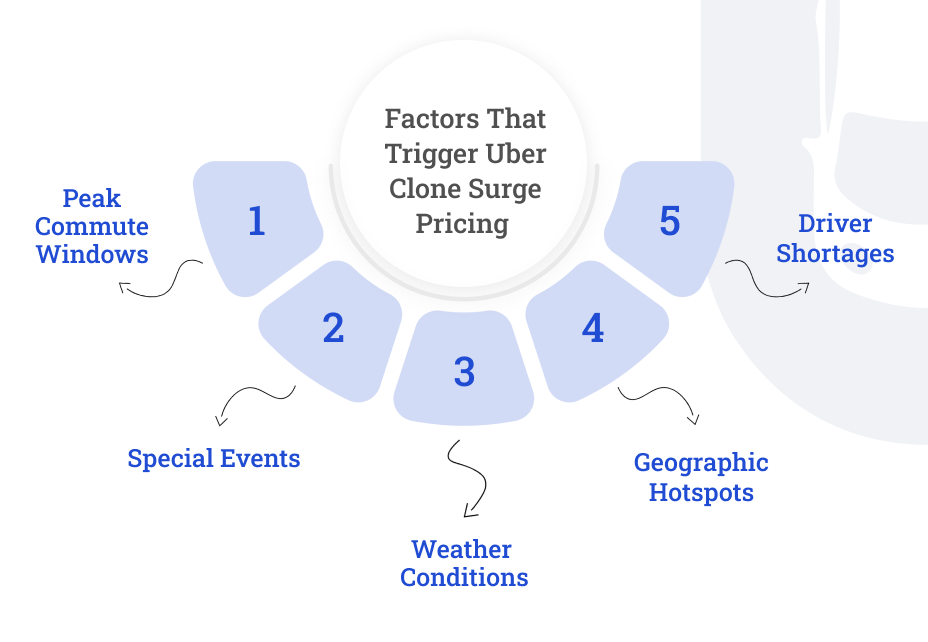
The algorithm activates automatically when the demand-supply gap crosses your configured threshold. But knowing what creates those gaps lets you plan ahead and turn reactive surge management into a deliberate revenue channel in your taxi business model.
Peak Commute Windows
Morning (7-9 AM) and evening (5-8 PM) on weekdays are the most predictable surge triggers in any urban market. Configure time-based rules in your admin panel, so surge activates automatically without manual intervention.
Special Events
Concerts, sports matches, festivals, and corporate conferences create localized demand spikes that can be 3-5× normal volume in a single zone. These are your highest-revenue surge opportunities.
Weather Conditions
Rain, extreme heat, and storms push riders off walking, cycling, and transit options – straight into your app. Rider demand spikes sharply while driver supply often dips simultaneously.
Geographic Hotspots
Airports, train stations, shopping malls, hospital districts, and business parks generate consistent demand clusters throughout the day. Zone these areas specifically in your surge configuration.
Driver Shortages
If a large portion of your driver fleet is offline due to shift changes, local events, or driver-side issues, supply drops even if demand stays constant. The algorithm detects this and activates surge to draw drivers back online.
Ready to Launch a Taxi Platform With Smart Surge Pricing Built in?
How Surge Pricing in Uber Clone App Benefits All Stakeholders – Not Just Your Business
This is the framing most operators miss – and it is the one that matters most for rider communication. Surge pricing in Uber clone is not a mechanism that benefits operators at the expense of everyone else. When configured correctly, it benefits every party in the ride-hailing ecosystem.
| 🏢 For Operators | 🚘 For Drivers | 👤 For Riders |
|---|---|---|
| Higher per-trip revenue during peak windows | Higher earnings incentivize drivers to go online | Guaranteed ride availability – surge keeps supply alive |
| Passive revenue optimization with no manual work | Reduces driver idle time – more demand per active hour | Upfront fare shown before booking – full transparency |
| Demand heatmap data for smarter future planning | Natural incentive without fixed bonus payouts | Riders can wait, pre-book, or accept – choice is theirs |
For Operators
Surge pricing converts your highest-demand moments – the windows when your platform is under the most pressure – into your highest-revenue moments. Without it, peak demand generates the same per-trip revenue as off-peak, while costing you more in operational strain.
Beyond immediate revenue, every surge event generates demand heatmap data. You learn which zones peak at which times, which events drive the most ride volume, and how your driver supply responds to price signals. This data compounds over time into a strategic planning asset.
For Drivers
Higher earnings during surge windows are the primary tool for drawing drivers onto the platform during high-demand periods. Drivers are rational economic actors – they respond to price signals. A 1.8× surge in the airport zone at 6 PM on a Friday will bring drivers to that zone without you sending a single message.
This mechanism also reduces driver idle time. During a surge window, demand is high, and drivers can complete back-to-back trips efficiently. Earnings per hour during a well-managed surge period can be 40-60% higher than during off-peak hours.
For Riders
This is counterintuitive, but true: riders benefit from surge pricing because without it, they would not get a ride at all. When demand overwhelms supply at a fixed price, available drivers get assigned immediately, and latecomers face a ‘no drivers available’ screen.
Surge pricing is the mechanism that keeps supply available. The rider who sees a 1.5× fare and books is getting a faster pickup than they would at the fixed fare, with no drivers available. And the rider who chooses to wait 15 minutes for the surge to drop is given that option transparently.
💡 Expert Note
Research in ride-hailing systems shows that surge pricing during peak demand events can reduce rider wait times by 30-50% compared to fixed-price conditions with overwhelmed supply. Frame surge to your riders as a reliability tool – not a premium charge. The messaging shift alone reduces backlash significantly.
Want to See the Surge Pricing Engine in Action on a Live Platform?
How to Communicate Surge Pricing to Riders Without Backlash?
Rider frustration with surge pricing is almost never caused by the price itself. It is caused by surprise. A rider who sees a 1.8× fare on the booking confirmation screen after entering their destination is angry. A rider who sees the same fare clearly displayed before they enter their destination makes a free, informed choice.
The transparency principle is non-negotiable: show the surge fare upfront, before the booking is confirmed, with a clear explanation of why it is active.
- In-app surge notification: Display a clear banner at the top of the booking screen – ‘High demand in your area. Fares are currently 1.7× the standard rate.’ Show the adjusted fare estimate immediately.
- Plain language surge reason: Replace technical language with human explanation. ‘Many riders are booking right now’ communicates the same information as ‘surge multiplier active’ and produces far less friction.
- Estimated surge duration: Where your platform’s data supports it, show riders an estimated time for the surge to subside. ‘Fares may return to normal in approximately 15 minutes’ gives riders a decision framework.
- Pre-booking as an escape route: Offer riders the option to schedule a ride for 30-60 minutes later at the standard fare. This converts riders who would abandon the booking into scheduled bookings – at no revenue loss.
- Proactive push notifications: Alert frequent riders before they open the app. ‘Your area usually surges between 5-7 PM. Book now or schedule ahead to lock in the standard fare.’ This positions your platform as a trusted advisor, not a surprise fee generator.
Surge Pricing vs. Fixed Fare vs. Pre-Booking – When to Use Each
Surge pricing is not the only pricing mode on a well-operated taxi platform. Smart operators combine three distinct pricing mechanisms and deploy each one for the rider type and occasion it serves.
| Pricing Mode | Best For | Revenue Impact | Rider Risk |
|---|---|---|---|
| Surge Pricing | Peak hours, events, and weather | High – per-trip spike | Backlash if uncapped or hidden |
| Fixed Fare | Airport, intercity, predictable routes | Stable – no upside during peak | Low – riders know the price |
| Pre-Booking | Price-sensitive riders, planned trips | Medium – fare locked in advance | Low – rider chose the price |
The operator who only runs surge pricing loses price-sensitive riders during peak hours. The operator who only runs fixed fares leaves significant revenue on the table during events and peak demand. The operator who pre-configures all three modes – and maps them to the right rider segments and occasions – maximizes both revenue and rider retention simultaneously.
Practically, this means: surge pricing as your default peak-demand mechanism, fixed fares for airport and intercity routes where predictability drives bookings, and pre-booking as an option surfaced proactively to frequent commuter-segment riders before surge windows open.
Metrics to Track the Performance of Your Uber Clone Surge Pricing Strategy
Surge pricing configured without measurement is surge pricing that cannot be improved. These are the five metrics that tell you whether your configuration is working – and when it needs adjustment.
| Metric | Healthy Target | What It Signals |
|---|---|---|
| Surge Revenue as % of Total Revenue | 15-25% | Revenue balance – too low means under-utilizing surge |
| Booking Acceptance Rate During Surge | >75% | Rider tolerance – below 60% means your multiplier is too high |
| Driver Online Rate During Surge Hours | Rising | Incentive effectiveness – drivers should come online as surge activates |
| Cancellation Rate During Surge | <20% | Red flag above 20% – cut your multiplier cap immediately |
| Zone-Level Demand Heatmap Accuracy | Weekly review | Data quality – drives smarter pre-event surge configuration |
Review these metrics as a set, not individually. A high booking acceptance rate with a low driver online rate means your multiplier is not high enough to incentivize supply. A low cancellation rate with low surge revenue means you are under-deploying surge in zones that could support a higher multiplier.
Zone-level demand heatmaps, tracked weekly, give you the strategic picture. See how Uber’s own data tells this story in Uber Statistics 2026 – a useful benchmark for understanding what peak demand patterns look like at scale.
💡 Expert Note
If your cancellation rate spikes above 20% during surge windows, your multiplier cap is too high for that market. Run a controlled 30-day test: lower the cap by 0.5× and track whether cancellations drop while total surge revenue holds. Operators consistently find that a lower multiplier with higher booking volume generates more total revenue than a high multiplier with significant abandonment.
Your Surge Pricing Engine Is Already Built. You Just Need to Activate It.
Most taxi operators treat surge pricing as something to build or integrate later – a complex feature requiring custom development and third-party tools. That is a costly misconception.
A modern Uber clone platform includes a fully operational surge pricing engine in the core product. Zone mapping, demand monitoring, multiplier configuration, rider notification flows, and real-time admin controls – all of it is built in and configurable from your admin panel from day one.
You are not choosing whether to implement surge pricing. You are choosing whether to configure it intentionally or leave revenue on the table. The operators who treat surge as a strategic system – not a default setting – generate significantly more revenue per peak hour and experience measurably lower rider churn because they pair surge with transparency.
If you are running a taxi business or planning to launch one, see how the pricing engine works on a live demo of our Uber clone app and walk away with a configuration strategy specific to your market.