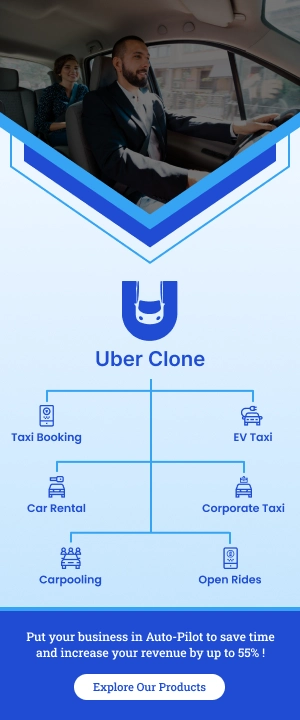
You have the vision to build a ride-hailing business that reshapes urban transportation, just like many brands have done globally. However, turning that into reality isn’t just about drivers and cars; it’s about building an ecosystem that handles millions of dynamic interactions within the system. That’s where understanding the core Uber Clone functionalities comes into the picture.
Understanding how app like Uber functions is essential for anyone planning to launch a taxi booking business. It gives a clear view of the core features, tech architecture, and workflow that enable seamless rides.
That is why, in this blog, we will dive into how each component of a ride-hailing platform like Uber works together to make it seamless and efficient.
The Multi-faceted Ecosystem: Key Factors of Uber Clone Functionalities
Let’s get a detailed understanding of the key components you will need to consider in order to build a highly functional Uber like platform.

Let’s get a detailed understanding of the key factors of the Uber clone functionalities from the points mentioned below.
Rider App
The rider app is the most essential component of any taxi booking business, as it enables customers to quickly book a ride.
It is not just a booking system but your business’s digital storefront. An efficient app creates a bridge between customers and the taxi service, where each interaction guides them towards a seamless mobility experience.
Driver App
The driver app is as essential as the rider app for the taxi booking business. The driver app is where the customer’s demands are fulfilled in real time. Without it, drivers have no structured way to connect with riders or navigate routes.
Web Panels
Web panels provide the operational backbone for how app like Uber functions to run the taxi business. These essential components are defined and built during the crucial development stages of an Uber like platform, designed to enable the admin, dispatcher, and partner to efficiently fulfill their tasks.
These web panels help them support, manage, and monitor the business with the help of advanced features.
Admin Web Panel
- Oversee the entire taxi booking operation from a centralized dashboard
- Access real-time analytics and reports to track performance
- Manage users, fares, zones, and promotions effortlessly
- Configure platform-wide settings and ensure operational efficiency
Dispatcher Web Panel
- Assign and track rides manually or through automated systems
- View live driver availability and customer requests
- Handle bookings during peak hours or in emergencies
Partner Web Panel
- Manage drivers and fleet performance
- Monitor earnings and ride history
- Receive insights to improve service quality
Customer Web Panel
- Book, cancel, or track rides seamlessly
- Access fare breakdown, ride history, and loyalty benefits
- Provide feedback and raise service concerns
- Receive notifications about ride status, offers, and driver details
Driver Web Panel
- View assigned rides, earnings, and schedules in one place
- Communicate with dispatch and customers efficiently
- Access trip history, ratings, and performance insights
- Update availability and vehicle status easily
Corporate Web Panel
- Centralized platform for managing all employee ride requests
- Add or remove an employee’s profile
- Track the employee’s rides in real-time
API Gateway & Integrations
The API gateway handles all important requests of the taxi booking system by connecting the front end with the back end. Every time a rider books a cab or a driver updates their status, APIs are silently making it all happen.
For example, when the rider enters the pickup and destination addresses, the API sends that information to the backend server. After that, it finds nearby drivers and sends options back to the app.
Breaking Down the Key Components of Uber Like Platform

The taxi app market size is expected to reach $283 billion by 2028, showcasing a huge potential for upcoming mobility businesses to grow.
However, before executing the taxi business plan, it is important to understand the key components of an app like Uber that play a vital role in making customers’ rides efficient.
Geo-Location & Route Navigation
Geo-location, or real-time tracking in an app like Uber, refers to the ability of a system to track the real-time location of the user through integrated GPS. When the rider selects the location, the system immediately pinpoints it on the map.
On the other hand, route navigation provides step-by-step navigation to users to reach a specific location.
Geo-location helps the system know where the users are, and route navigation helps them get where they need to go. Together, they power the real-time efficiency of a taxi booking business.
Intelligent Ride-Matching Algorithms
Intelligent ride-matching algorithms are like a logic engine for a taxi booking system. It automatically matches riders with the most suitable drivers in real-time.
They use multiple dynamic parameters to ensure that every ride is quickly assigned.
How does it work?
When a rider requests a trip, the system quickly runs a calculation across a pool of available drivers. This is done on the basis of proximity, driver availability, and the ride type selected by the rider.
In simple terms, it is the visible brain behind the quick ride matching and smooth operations in a taxi booking system. The efficiency of the ride-matching algorithm determines how well your platform performs when it receives hundreds of ride requests.
Smart Dispatch Engine
The smart dispatch engine encompasses a broader operational framework. It not only uses the ride-matching logic but also manages the entire dispatch flow.
It includes driver filtering, assignment rules, a retry mechanism, a reallocation strategy, and demand-supply balancing.
Predictive ETA (Estimated Time of Arrival)
Predictive ETA calculates and displays the expected arrival time of a driver to the customer. It uses both real-time and historical data for accurate prediction.
The system uses a combination of:
- Real-time traffic data
- The driver’s current GPS location
- Distance between points (pick up & drop)
- Time of day and day of the week patterns
- Historical trip data on similar routes
- Average driver speed and road conditions
For example, if a rider in downtown Toronto books a cab at 6:00 PM, the system doesn’t just calculate the distance but factors like evening traffic, ongoing construction, weather, and much more.
So, predictive ETA is not just a timer; it is a real-time intelligent estimator that builds rider confidence, reduces wait-time stress, and improves overall experience.
Traffic Congestion Levels
The traffic congestion levels feature helps the system and your drivers make smarter decisions on the road.
By tapping into real-time traffic data, the platform can detect which areas are facing slowdowns, heavy congestion, or roadblocks.
This information is used in multiple ways: it adjusts the driver’s route to avoid traffic, recalculates the ETA for more accurate arrival times, and even factors into fare estimation when pricing is time-based.
For dispatching, it helps the system avoid assigning a driver who’s stuck in traffic to a nearby booking, which reduces delays and improves overall trip efficiency.
With Our Robust Uber Like Platform, Launch a Relevant, Efficient, and Future-Ready Mobility Business that Grabs Customers’ Attention
AI-Based Features that Enhance User Experience
Intelligent operating systems and AI integration are a crucial part of the functionalities of an app like Uber because they transform a basic platform into a smart and responsive system. These advancements are key to defining the future of Uber like platforms and maintaining a competitive edge.
Additionally, using AI in business is proven to be a game-changer since it is more accurate and efficient than conventional systems.
The below statistic indicates AI adoption has become mainstream across industries worldwide.

Heatmap-Based Driver Reallocation
Heatmap-based driver reallocation is all about putting drivers where they’re needed most before the demand even peaks.
Imagine a live map that shows which areas are lighting up with ride requests and which zones are quiet.
The system uses this data to highlight hotspots, places where more people are booking rides, and suggests drivers move toward those high-demand zones.
This helps reduce wait times for riders, boosts the chances of drivers getting back-to-back trips, and keeps the entire system running more efficiently. Whether it’s rush hour in the city center or a sudden surge after a concert, heatmaps help your fleet stay one step ahead.
Chatbots & Voice Assistants
As per the recent report of The Business Research Company, the AI chatbot market size will grow to $31.11 billion by 2029.
Chatbots are text-based AI assistants embedded in rider and driver apps (or on the website) to guide users and solve their queries.
They use NLP (natural language processing) to interact with them and trigger relevant query answers within the platform.
It works as an intelligent, always-available support system for users, which enhances their experience through real-time communication.
AI-Powered Business Analytics Dashboard
The AI-powered business analytics dashboard acts as a central hub that summarizes important data into actionable insights.
The dashboard presents data through dynamic charts, graphs, and KPI tiles, making it easy to track:
- Daily/weekly/monthly revenue trends
- Booking volume by location
- Average driver response time and trip duration
- Total trips completed by drivers
Ending Notes
Understanding the core functionalities of an Uber like platform gives comprehensive insights into how an ideal taxi booking business works. From backend operations such as ride-matching, geo-location to interactive AI-based dashboards for business insights, each module works in sync for optimum ride management.
If you want to build such a robust system, connect with our team and learn how our Uber clone solution can help you build a thriving ride-hailing business. Until then, stay tuned for informative blogs about the mobility industry.
FAQs